
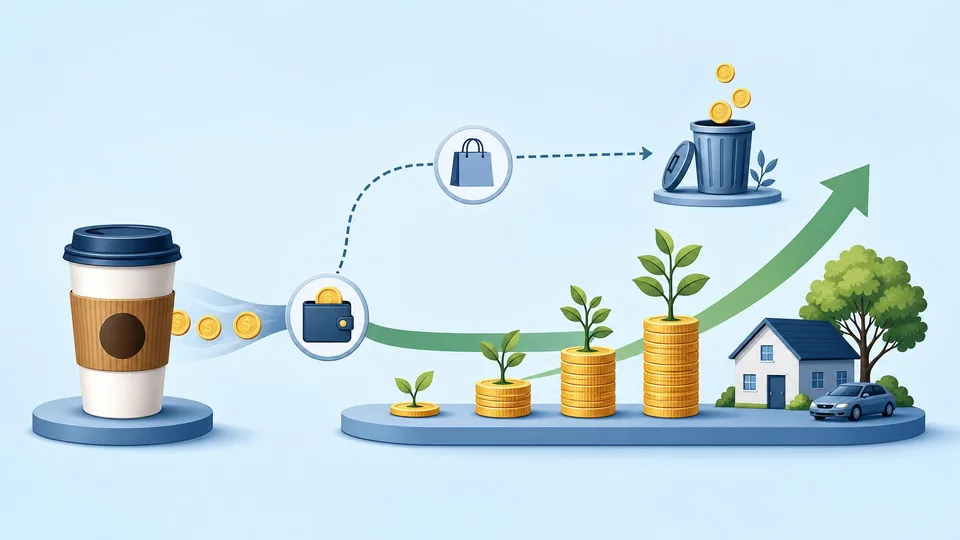
I'm not someone who thinks every £4 coffee needs defending — but I've found it genuinely useful to understand what small regular purchases actually cost over time, separately from judging whether they're worth it.
The standard objection to small-purchase analysis is that it misses the point. Life is short, coffee is good, and obsessing over £4 decisions is no way to live. This is fair. But there is a difference between consciously choosing to spend money on things that genuinely improve your day, and spending it habitually without ever examining the total cost. The goal here is the latter: visibility, not restriction.
Why Small Spending Matters
Individual small purchases do not feel significant because they are not. The problem is frequency. A £4 decision made once is irrelevant. The same decision made every working day for 20 years is a £20,800 cash outflow — and a much larger foregone investment value.
Small spending also escapes scrutiny in a way that large spending does not. People think carefully about a £600 appliance. They do not think at all about a £6 transaction. The cumulative result of hundreds of unexamined small decisions can easily exceed the cumulative result of a handful of large ones.
Opportunity Cost Explained
Opportunity cost is what you give up by choosing one option over another. When you spend £5, you are not only spending £5 today — you are also forgoing what that £5 could have become over time.
At 7% annual growth: £5 today becomes roughly £10 in 10 years, £20 in 20 years, and £38 in 30 years. Individually, not significant. But £5 per day over 30 years — £1,825 annually — invested instead grows to approximately £175,000. The daily amount was trivial. The cumulative opportunity cost is not.
This is not an argument for eliminating daily spending. It is an argument for quantifying it. The Impulse Purchase Cost Calculator converts any regular spending amount into its long-term opportunity cost. Enter the daily or weekly amount, the frequency, and the investment horizon. The output shows what that spending pattern is costing in foregone wealth — not as a moral judgement, but as a number you can weigh against the value you receive.
Daily vs Annual Impact
The fastest way to make small costs tangible is annualisation. Here are common spending habits with their annual cash cost:
- £4 daily coffee on workdays (250 days): £1,000/year
- £4 daily coffee every day: £1,460/year
- £3 daily snack or drink: £1,095/year
- £12 lunch out twice a week: £1,248/year
- £8 delivery fee three times a week: £1,248/year
- Three streaming subscriptions at £12 average: £432/year
- £30 monthly app and digital subscriptions: £360/year
A person running most of these habits simultaneously is spending approximately £6,000 to £7,000 per year on items that individually felt insignificant. Invested at 7% over 25 years, £6,500 per year becomes approximately £440,000. Over 20 years: approximately £295,000.
The numbers are not designed to make anyone feel bad. They are designed to answer the question most people never ask: what is this actually costing me?
The Visibility Problem
The reason small spending is rarely examined is that its cost is never concentrated. A single annual bill for £6,000 would receive serious attention. The same amount distributed across 300 transactions of £20 or less over a year flies under the cognitive radar. Contactless and one-click payments have made this worse by removing the tactile and psychological friction of handling physical money.
The practical response is to make the invisible visible: a monthly audit of card statements, sorted by category, shows the true total of any spending category. Most people are surprised by what they find in at least one category. The surprise is the point.
Making the Decision Deliberately
The goal is not to eliminate enjoyable spending. It is to make it a choice rather than a default. A person who looks at the numbers and decides that a daily bought coffee is worth £1,460 per year to them has made a legitimate financial decision. A person who has never looked at the numbers has not made a decision at all — they have simply continued a habit whose cost they do not know.
The calculator exists to enable the former. Run the numbers, decide what is worth it, and spend deliberately rather than by default.