
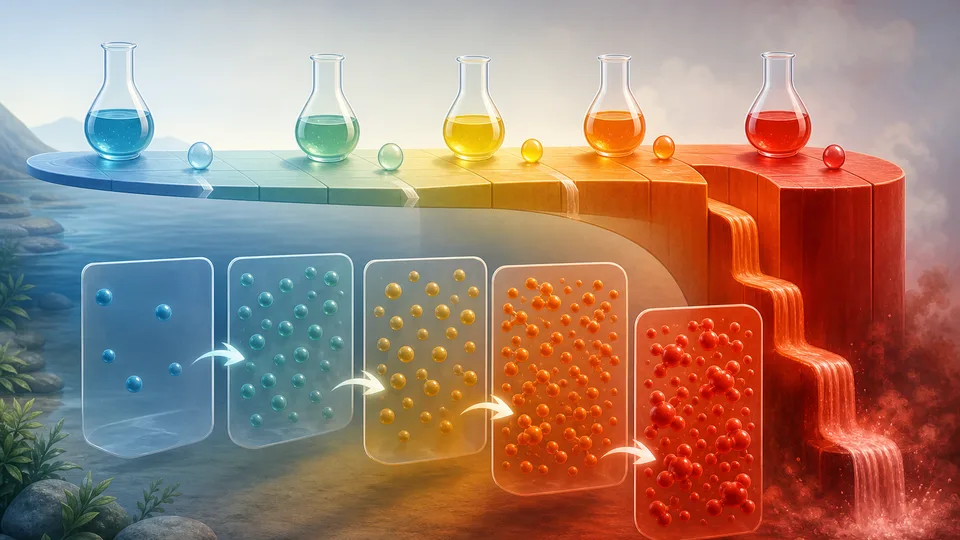
The pH scale can feel backward at first. A lower pH means more acidity, not less. A pH of 3 is more acidic than a pH of 5, and the gap is not just two ordinary units. Because pH is logarithmic, that two-step difference represents a hundredfold difference in hydrogen ion concentration.
The pH calculator helps convert between pH and hydrogen ion concentration, but the result is easier to interpret when the scale itself makes sense. pH is not simply a colour chart. It is a compact way to describe how acidic or alkaline a solution is.
What pH Measures
pH is tied to hydrogen ion concentration in a solution. In simplified terms, more hydrogen ions mean more acidity. The pH value is defined using a negative logarithm, which is why the scale runs in the direction that often surprises people: more hydrogen ions produce a lower pH number.
Pure water at room temperature is often described as neutral at about pH 7. Acidic solutions have pH values below 7, and alkaline or basic solutions have pH values above 7. This neutral point is a useful classroom anchor, but real measurements can depend on temperature, solution composition, and measurement method. A calculator can handle the arithmetic; it does not certify a sample.
Why the Scale Runs Backwards
The negative sign in the pH definition is there because hydrogen ion concentrations are usually small decimals. Instead of writing 0.000001 moles per litre, pH lets you write a more manageable number. A hydrogen ion concentration of 10 to the negative 6 corresponds to pH 6. A concentration of 10 to the negative 3 corresponds to pH 3.
Notice what changed. The concentration got larger when the exponent moved from negative 6 to negative 3, but the pH number got smaller. That is the “backwards” feeling. It is not arbitrary; it is a consequence of using a negative logarithm to make tiny concentration values easier to compare.
One pH Step Is a Tenfold Change
Because pH is logarithmic, each whole pH step represents a factor of ten in hydrogen ion concentration. A solution at pH 4 has ten times the hydrogen ion concentration of a solution at pH 5. A solution at pH 3 has one hundred times the hydrogen ion concentration of a solution at pH 5.
This is the most important interpretation habit. A difference of 1 on the pH scale is not like a difference of 1 degree or 1 metre. It is a multiplier. That is why pH changes that look small on paper can represent meaningful chemical differences.
Acidic, Neutral, and Alkaline
For introductory use, the pH scale is usually divided into acidic below 7, neutral around 7, and alkaline above 7. Lemon juice, vinegar, and similar examples are acidic. Soap solutions and many cleaning solutions are alkaline. Water is used as the neutral reference in many explanations.
Those examples are helpful, but they should not turn the calculator into a safety guide. The same pH value can appear in different contexts with very different handling requirements. Concentration, chemical identity, buffering, temperature, and exposure all matter. This article is about calculator interpretation, not lab safety, product handling, or health advice.
Converting pH to Concentration
To move from pH to hydrogen ion concentration, reverse the logarithm. A pH of 5 corresponds to 10 to the negative 5 in the usual simplified concentration expression. A pH of 8 corresponds to 10 to the negative 8. The lower pH has the larger hydrogen ion concentration.
The calculator is useful when the pH is not a neat whole number. A pH of 6.3 still fits the same relationship, but the concentration is not as easy to do in your head. The calculator keeps the exponent and decimal work tidy so you can focus on whether the inputs and interpretation make sense.
Converting Concentration to pH
To move from hydrogen ion concentration to pH, use the negative logarithm. If the concentration is written in scientific notation, the exponent gives you a rough expectation. A concentration near 10 to the negative 4 should produce a pH near 4. A concentration near 10 to the negative 9 should produce a pH near 9.
This expectation check is useful because concentration values can be typed incorrectly. One misplaced zero changes the result by a whole pH unit. If the calculator returns a number that feels far away from the exponent you entered, check the notation before trusting the result.
Where pOH Fits
Some chemistry problems also use pOH, which is related to hydroxide ion concentration. In many introductory water-based examples at room temperature, pH and pOH add to 14. That relationship is useful in classroom problems, but it has assumptions behind it. Temperature and context can change the exact relationship.
If the calculator includes pOH, treat it as another linked logarithmic scale rather than a separate mystery. The same habits apply: identify which concentration is being used, watch the sign, and remember that whole-number steps represent factors of ten.
How to Use the Calculator Well
Start by deciding what you have: pH, hydrogen ion concentration, pOH, or hydroxide ion concentration. Enter only the value that matches the chosen conversion. Keep scientific notation clear. If you mean 1 times 10 to the negative 6, do not type it as a loose decimal unless you are confident the zeros are correct.
Then read the answer as a scale interpretation, not just a number. Ask whether the solution is acidic, neutral, or alkaline in the simplified sense. Ask whether the difference between two values is a multiplier. If the work is part of a wider chemistry calculation, connect it to related tools such as the molarity calculator or dilution calculator.
Why Approximation Is Normal With pH
pH values are often reported with limited decimal places because measurement conditions and instruments have practical limits. A calculator can output more digits than a real measurement deserves. If an input pH is given as 6.5, do not treat a converted concentration with six decimal places as if it has six decimal places of certainty.
This matters when comparing values. A small reported difference may be meaningful in a controlled chemistry problem, but in real samples it may also reflect measurement method, temperature, calibration, or rounding. The calculator is best used for understanding the relationship between pH and concentration, not for declaring the quality, safety, or suitability of a substance.
Buffering Changes How pH Responds
Some solutions resist pH change because they contain buffering systems. A buffered solution can absorb added acid or base without changing pH as quickly as pure water would. That does not invalidate the pH scale, but it does mean pH is only one part of the story when a solution is being changed or mixed.
If you are working through classroom buffer problems, the buffer pH calculator may be a better match than a simple pH conversion. Use the simpler calculator when the task is converting pH and concentration. Use the buffer tool when the task involves acid-base pairs and their relative amounts.
FAQ
Why does lower pH mean stronger acidity?
pH uses a negative logarithm of hydrogen ion concentration. More hydrogen ions mean a larger concentration but a lower pH number.
Is pH 4 twice as acidic as pH 8?
No. pH is logarithmic. A four-step pH difference represents a ten-thousandfold difference in hydrogen ion concentration in the simplified scale.
Can pH be below 0 or above 14?
In advanced or concentrated contexts, values outside the common 0 to 14 classroom range can occur. The simple range is a useful introductory guide, not a universal boundary.
Is this medical or safety advice?
No. This is an educational explanation of calculator inputs and the pH scale. It does not replace lab procedures, safety data sheets, product instructions, or professional guidance.