
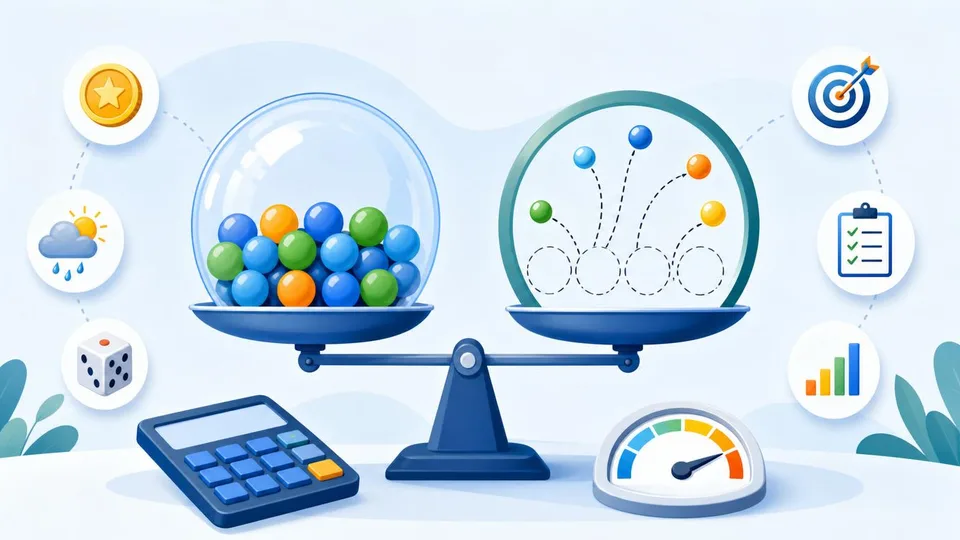
I once worked with a manager who refused to dismiss any low-probability scenario in planning meetings on the grounds that it "could happen". In principle, this is reasonable caution. In practice, it made decisions almost impossible — every plan had to accommodate an ever-expanding list of unlikely events, all treated with equal seriousness. The possibility that a supplier would deliver late and the possibility that the building's roof would collapse were both real possibilities. The probabilities were not remotely comparable. Treating possibility as a substitute for probability — letting "it could happen" carry the same weight as "it is likely to happen" — produces plans that try to optimise for everything and therefore optimise for nothing.
What Possibility Means
Possibility is binary: an event is either possible or it isn't. Something is possible if there exists any scenario in which it occurs. Winning the lottery is possible because there exist ticket number combinations that match the draw. Being struck by lightning is possible because lightning strikes do land on people. Living to 120 is possible because some people have done it. Possibility makes no claim about frequency or likelihood — it simply establishes that the event can happen.
What Probability Means
Probability is a measure of how likely an event is, expressed as a number between 0 and 1. A probability of 1 means certainty. A probability of 0 means impossibility. A probability of 0.01 means the event occurs in about 1 in 100 trials under the same conditions. Unlike possibility, probability is continuous — it scales with the evidence and the mechanism that generates the event.
Probability = (number of favourable outcomes) ÷ (total number of possible outcomes), for equally likely outcomes. Our probability calculator handles single events, independent combined events, and binomial distributions — useful when you want to move from intuition to a precise number.
Why the Confusion Matters
The pattern "it's possible, therefore it's worth taking seriously as likely" is a genuine cognitive error. Possible events span an enormous range of probabilities — from one in a trillion to near-certainty. Treating all possible events as equally deserving of concern wastes attention on the wildly improbable while underweighting the merely unlikely-but-real. Insurance companies, public health officials, and engineers all use probability rather than possibility for resource allocation precisely because possibility alone provides no basis for prioritisation.
Theoretical vs Empirical Probability
Theoretical probability is calculated from the structure of the problem — a fair coin has a 50% theoretical probability of heads because there are two equally likely outcomes. Empirical probability is calculated from observed data — if a machine produces defective parts 3.2% of the time based on the last 5,000 parts inspected, the empirical probability of a defect is 0.032.
Theoretical and empirical probabilities often differ, especially in small samples. Flipping a fair coin 10 times might produce 7 heads — an empirical rate of 70% — without the coin being biased. In 10,000 flips, the empirical rate will typically be much closer to 50%. Small samples produce misleading empirical probabilities; understanding this is one of the most practically important ideas in statistics.
Risk, Uncertainty, and Their Difference
Economists distinguish between risk (where probabilities are known or estimable) and uncertainty (where probabilities genuinely cannot be assigned). Insuring a car involves risk — actuaries can calculate accident probabilities from population data. Starting a genuinely novel business in an untested market involves uncertainty — there's no comparable data from which to derive reliable probabilities.
This distinction matters because the decision-making tools appropriate for risk (expected value calculations, insurance, hedging) are less useful under uncertainty. Under deep uncertainty, qualitative judgements about upside and downside scenarios, and attention to resilience rather than optimisation, tend to be more appropriate than probability calculations that would be spuriously precise.
The Practical Implication
When you hear "it's possible that X will happen", the next question to ask is always "what's the probability?" If someone says "it's possible this investment will fail", that's true of almost any investment. What matters is the estimated probability of failure and the magnitude of the consequence if it does. Possibility without probability is not useful information for decision-making. It establishes only that the event has a non-zero probability — which covers an enormous range from "happens constantly" to "has never been observed".
Why Plane Crashes Feel More Dangerous Than Car Journeys
Statistically, flying is orders of magnitude safer than driving. The fatality rate per kilometre travelled by commercial aircraft is roughly 50 times lower than by car, and in most years the absolute number of deaths from commercial aviation globally is less than 1,000. Road deaths in the UK alone exceed 1,700 per year. Yet most people report feeling more anxious about flying than about driving. The reason is not probability — it's vividness and perceived control.
When a plane crashes, it's a major news event. Hundreds of people die in a single incident, the story dominates headlines for days, and the images are dramatic. The slow accumulation of individual road deaths, by contrast, generates almost no media coverage despite causing far more harm in aggregate. Our brains judge probability by how easily examples come to mind — a cognitive bias called the availability heuristic. Dramatic, memorable, and widely-reported events feel more probable than they are. Routine, undramatic events that cause more harm in total feel safer than they are.
Probability corrects this by replacing intuition with counted evidence. The actual risk of any transport mode is measurable. Perceived risk tracks salience and emotional intensity rather than frequency. Understanding this gap between felt probability and real probability isn't just academic — it affects which risks we mitigate, which ones we insure, and which ones we expose ourselves to without concern because they don't feel dangerous even when they are.