
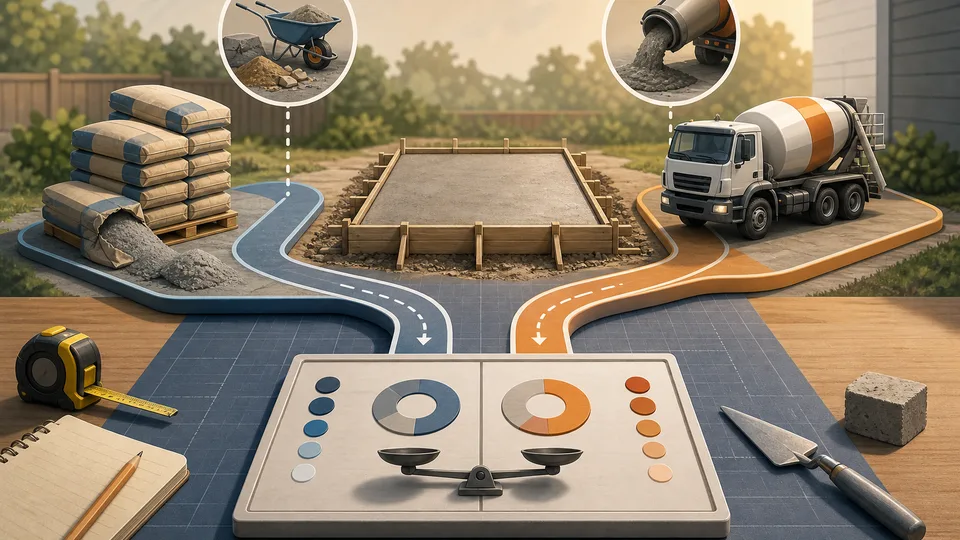
Small concrete pours look simple until you price them. A few fence posts, a shed base, a small path repair, or a step pad may not justify a full ready-mix delivery, but bagged concrete can become expensive and labour-heavy when the volume creeps up.
The right comparison starts with volume, but it does not end there. Bag yield, waste allowance, bag price, ready-mix minimums, delivery fees, small-load charges, and the effort of mixing all change the practical answer.
The Concrete Bag Calculator helps estimate bag counts and compare bagged mix with manual ready-mix assumptions. It is a planning tool, not a structural design or supplier quote.
Start with the concrete volume
Every concrete estimate begins with volume. For a simple rectangular slab, multiply length by width by depth. For post holes, use the hole shape and depth. For awkward shapes, break the job into smaller sections and add the volumes together.
If you only need concrete volume, the Concrete Calculator is the simpler starting point. The bag calculator becomes useful when you need to convert that volume into bag counts and compare buying routes.
Depth matters a lot. A small increase in depth can add a surprising amount of concrete. Before pricing bags or delivery, make sure the dimensions and units are consistent.
Bag yield is the key bagged-mix input
Concrete bags are usually sold by weight, but the useful planning figure is yield: how much wet concrete one bag produces. Different bag sizes and mixes can produce different yields, so do not assume every bag covers the same volume.
If the bag yield is low, the required count rises quickly. A small pour can move from manageable to awkward once the number of bags means repeated mixing, lifting, water measuring, and cleanup.
Use the yield printed by the product or supplier. If you do not have it yet, use a cautious assumption and update the calculation before buying.
Waste and rounding are not optional
You cannot buy 18.3 bags. You buy 19, and often you buy a little more because small losses happen during mixing, placing, uneven excavation, spillage, or depth variation.
Waste allowance is especially important for hand-dug areas. A post hole or small excavation may be wider, deeper, or less regular than planned. The concrete does not care that the drawing was neat.
Do not let waste become a substitute for bad measuring. Measure carefully first, then add a reasonable allowance. Guess first and buffer later is how small jobs become expensive.
Ready-mix has minimums and delivery friction
Ready-mix pricing is not just price per cubic metre or cubic yard. Suppliers may have minimum billed quantities, delivery fees, waiting-time rules, small-load charges, or access requirements.
That means the ready-mix option may look cheap per unit but expensive for a tiny job. If you need much less than the minimum billed amount, you may pay for concrete you do not use.
On the other hand, ready-mix can become attractive when bag counts are high. Mixing dozens of bags by hand takes labour, time, water control, and physical effort. The cheapest material line is not always the cheapest job.
Compare total job cost, not only material cost
Bagged concrete often has lower delivery friction, especially if you can collect it or add it to another materials order. But many bags mean more manual work. Ready-mix can reduce mixing effort but may require better site preparation, access, timing, and minimum charges.
A fair comparison includes bag price, bag count, waste allowance, ready-mix price, minimum billed quantity, delivery fee, small-load fee, and any fixed costs. The Concrete Bag Calculator is built around that comparison.
A simple example
Imagine a small slab that needs 0.35 cubic metres of concrete. If one bag yields 0.01 cubic metres, the raw count is 35 bags. Add 10% waste and the required count becomes about 39 bags after rounding.
If each bag costs 6, the bagged material cost is 234 before delivery or collection effort. If ready-mix costs 120 per cubic metre but has a 1 cubic metre minimum plus a delivery fee, the ready-mix total may still be higher despite the lower unit price.
Now change the volume to 0.8 cubic metres. Bag count and manual labour rise sharply, while the ready-mix minimum becomes less wasteful. The better option can change just because the pour is larger.
What this calculation does not decide
This comparison does not choose concrete strength, reinforcement, slab specification, curing method, structural suitability, or building-code compliance. Those decisions matter, but they are outside a simple calculator.
It also does not fetch live supplier pricing. You enter the manual prices and fees you want to compare. That keeps the tool transparent, but it means the quality of the answer depends on current local assumptions.
Think about labour and sequencing
Bagged concrete changes the work on the day. Someone has to move the bags, mix them consistently, add water, place the mix, clean tools, and keep the pour moving. For a very small job this may be straightforward. For a larger small pour, the labour becomes part of the decision.
Ready-mix changes the pressure in a different way. The concrete arrives on a schedule, so the formwork, access, tools, and people need to be ready before delivery. That can be efficient when the site is prepared, but stressful when the job is still being set up.
This is why the best option is not always the one with the lower material cost. Bagged mix can spread the work across your own pace. Ready-mix can reduce mixing effort but requires more coordination. The calculator gives a cost comparison; you still need to think about the work pattern.
Check access before choosing ready-mix
A ready-mix price is only useful if the concrete can realistically reach the pour area. Tight lanes, limited parking, long carries, slopes, steps, gates, and restricted delivery windows can all change the practical choice.
For very small jobs far from easy access, bags may be more manageable even if the unit cost is higher. For jobs with easy access and a larger volume, ready-mix may save time and produce a more consistent pour.
Do not use this comparison to skip site preparation. Whether you use bags or ready-mix, the form, dimensions, base preparation, tools, and working area should be ready before the concrete is mixed or delivered.
Common small-pour mistakes
Pricing only the raw concrete. Delivery, minimum quantities, extra bags, small-load fees, collection time, and mixing labour all affect the real answer.
Underestimating depth variation. If the excavation is uneven, the actual volume may be higher than the neat calculation.
Buying exact bag count. Rounding and waste matter. A shortfall near the end of a pour is more annoying than a small surplus.
Using the calculator as a specification. Quantity planning is not the same as structural design, mix selection, reinforcement, or building-code compliance.
Where material take-off fits
Concrete is often one line in a bigger job. A fence project may also need posts, rails, panels, fixings, and gravel. A path may need sub-base, formwork, edging, and disposal. The Material Take-Off Calculator can help when concrete is part of a wider materials list.
FAQ
Are concrete bags cheaper than ready-mix?
Sometimes. Bags can be better for very small pours, but ready-mix can become more practical when bag count, labour, and time rise.
Why does ready-mix have a minimum billed amount?
Delivery, batching, vehicle time, and small-load logistics still cost money even when the concrete volume is small. The calculator lets you enter those assumptions manually.
Should I include waste?
Yes. Excavations and forms are rarely perfect, and bags must be rounded up. A modest waste allowance is usually safer than buying the exact raw volume.
Does this calculator specify concrete strength?
No. It estimates quantity and rough cost from manual inputs. It does not provide mix design, structural advice, reinforcement guidance, or code compliance.