
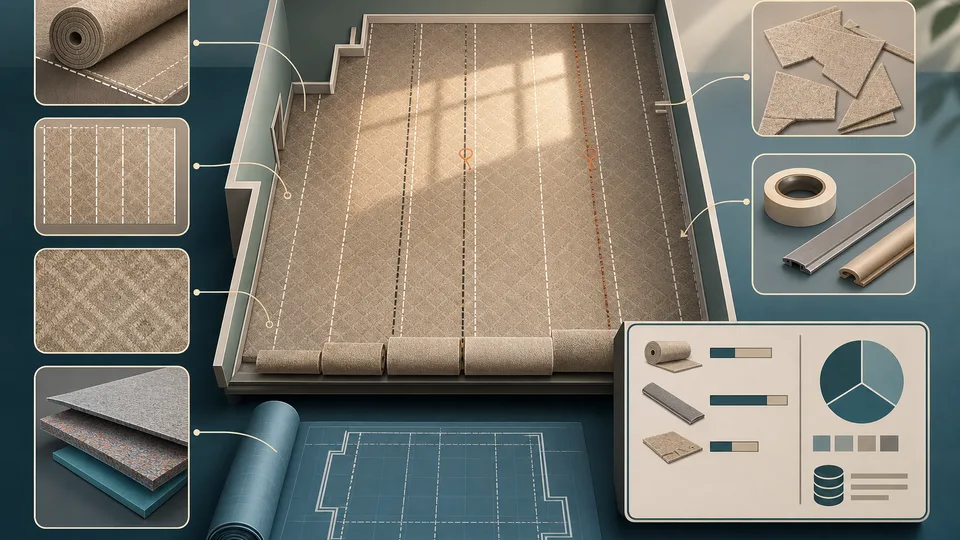
Carpet looks like an area problem until the roll width gets involved. A room can have a simple square-foot total and still produce an awkward carpet order because the material comes from a roll, not from neat packs that fit every shape equally well.
That is why I treat carpet as a strip-and-roll problem first, then an area problem second. The floor area tells you roughly how large the room is. The roll width tells you how many strips are needed, where seams may appear, how much linear length is required, and how much extra is sensible for trimming or pattern matching.
The Carpet Roll Calculator helps estimate roll length, strip count, likely seams, pattern allowance, trim waste, underlay, fitting or accessory allowance, and rough material cost. It complements the Flooring Calculator, which is better for general area and pack-count estimates.
Why carpet is not just square footage
Square footage is useful because every flooring project starts with the space being covered. But carpet is often sold by roll width and linear length. If the room is wider than the roll, one strip is not enough. If two or three strips are needed, seams and pattern alignment become part of the estimate.
A 12-foot-wide roll can cover a room that is 11 feet wide with one strip if the length works. A room that is 13 feet wide may need two strips even if its total area is not much larger. That extra strip can create offcuts, seam planning, and more material than a plain area calculation suggests.
This is why early carpet estimates should show both the area and the roll logic. Otherwise the number can look precise while hiding the issue that changes the order.
Start with room direction and roll width
The first practical question is which way the carpet will run. In a simple rectangular room, the roll may run along the room length or across the room width. The best direction depends on room shape, roll width, doorway position, pattern, pile direction, and where a seam would be least noticeable.
For a planning estimate, enter the room length, room width, and product roll width. The calculator can then estimate how many strips are needed across the room. That strip count is the first clue that a seam may be involved.
Do not treat that as final seam placement. A fitter may rotate the layout, move a join, or suggest a different direction for appearance and wear. The estimate is there to make the likely order size visible before you talk to the supplier.
Seams change the conversation
A seam is not automatically a problem, but it is something to plan. If the room needs two strips, there will usually be at least one join. The join may be hidden under furniture, placed away from the main traffic path, or aligned with a doorway where possible.
Early estimates should not pretend seam placement is a simple calculator decision. The useful part is knowing that a seam is likely. That helps you ask better questions before buying: where would the join go, does the pattern need matching, does the pile direction matter, and would a wider roll avoid the join?
If a supplier quote is higher than your square-foot estimate, seams and roll direction are often part of the reason. Compare the strip count before assuming the quote is padded.
Pattern repeat can add length
Plain carpet is easier to estimate than patterned carpet. A repeating pattern may need extra length so the design lines up between strips. That extra length is not waste in the casual sense; it is material used to make the finished floor look right.
If the product listing gives a pattern repeat, include an allowance before final waste is applied. The larger the repeat and the more strips involved, the more important this becomes.
Pattern matching is one of the areas where installer judgement matters. The calculator can help you budget for extra length, but it does not decide how the pattern should be aligned in the actual room.
Waste is not the same as overbuying
Carpet waste covers trimming, imperfect walls, doorway cuts, fitting tolerance, and offcuts created by roll width. A waste allowance is there because a real room is not a perfectly cooperative rectangle.
Too little waste can be expensive if the carpet runs short and a matching piece is not available. Too much waste is frustrating because carpet is bulky and costly. The right allowance depends on the room, pattern, roll width, and supplier advice.
Use the calculator result as a conversation starter, not a final purchase instruction. If the room has odd corners, multiple doorways, or a patterned product, ask the supplier or fitter to confirm the allowance.
Do not forget underlay and accessories
Carpet is rarely just carpet. Underlay, gripper rods, thresholds, tape, adhesive, trims, and fitting accessories can all affect the shopping list. The material cost can look artificially low if those items are ignored.
Underlay is usually closer to an area estimate than a roll-width estimate, but it still needs a waste allowance. Accessories may be priced as a fixed allowance or checked from the room layout.
For a bigger renovation, use the Multi-Room Area Calculator first if several rooms need measuring, then use the carpet roll estimate room by room where roll width and seams matter.
A simple worked example
Suppose a room is 15 feet long and 13 feet wide, and the carpet roll is 12 feet wide. One strip cannot cover the width, so two strips are likely. If each strip needs to run the room length, the raw linear length is roughly 30 feet before pattern repeat and trim allowance.
If the same room were 11 feet wide, one strip might be enough, giving a very different order even though the room area is only modestly smaller. That is the point: width relative to roll width matters.
Add pattern repeat if required, then add waste for trimming and fitting. Add underlay, accessories, and any fitting allowance separately so the carpet price does not pretend to be the whole job.
Checklist before you trust the carpet estimate
Before treating the result as a buying guide, check five things. First, confirm the product roll width, because one wider or narrower option can change the number of strips. Second, decide which direction the carpet is assumed to run, even if the fitter later changes it. Third, note whether the carpet has a pattern repeat, stripe, or pile direction that could affect matching.
Fourth, separate carpet length from underlay and accessories. A low carpet-only figure can be misleading if underlay, thresholds, gripper, delivery, and fitting materials are missing. Fifth, keep the room sketch beside the number. If the supplier suggests a different layout, you will be able to see whether the difference comes from seam placement, waste, pattern alignment, or a measurement error.
What the calculator should not decide
The calculator does not choose seam placement, assess pile direction, plan stairs, decide thresholds, or replace installer measurement. It also should not be used as a legal room measurement or property listing standard.
Use it to understand the buying logic. Then confirm roll width, product repeat, seam position, underlay, gripper, threshold trims, delivery, and fitting details before placing an order.
A good carpet estimate is one you can explain: room size, roll width, strips, seams, repeat, waste, underlay, and accessories. Once those pieces are visible, the quote becomes much easier to judge.