
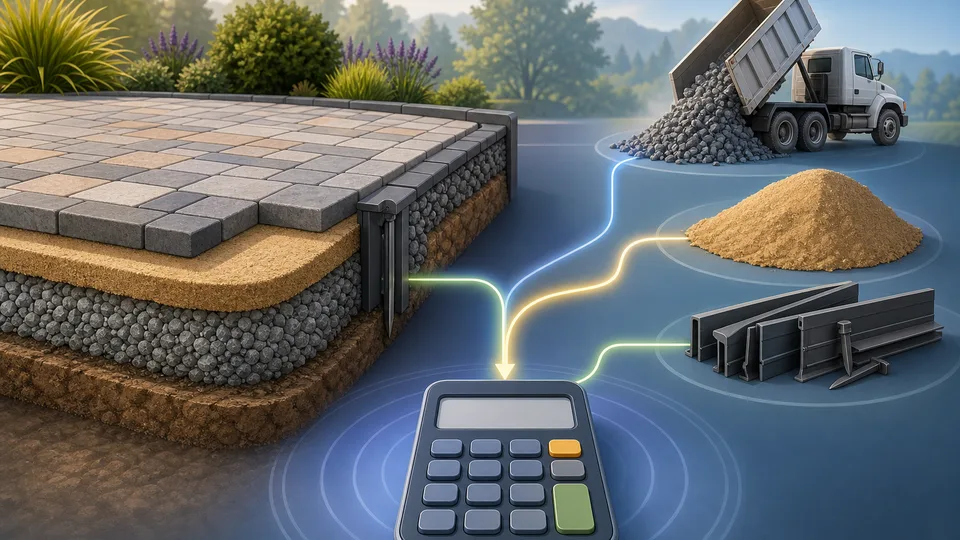
Pavers are the visible part of a patio, path, or small hard-landscaping project, but they are not the whole materials list. Under the pavers sit base aggregate and bedding sand. Around them may be edging. Behind the estimate sit delivery, tonnage, waste, and unit-cost assumptions.
This is why a paver count alone can feel accurate and still leave the project under-planned. You may know how many pavers you need while still not knowing how much base material to order.
The Paver Base Calculator focuses on the layers underneath and around the pavers: base aggregate, bedding sand, edging, delivery, tonnage, and material cost. It complements the Paver Calculator, which stays focused on paver count.
Pavers are only the top layer
It is natural to start with the visible surface. Length and width tell you the area, and the paver size tells you roughly how many units are needed. That is useful, but it does not prepare the ground.
The supporting layers are what turn the surface area into a material plan. The base layer provides the bulk of the build-up. The bedding layer helps support and level the pavers. Edging helps hold the perimeter in place. Each layer has its own depth, density, waste, and cost assumptions.
Base aggregate drives most of the volume
Base aggregate is usually the largest hidden material line. Its volume depends on project area and base depth. A small change in depth can add a meaningful amount of material, especially over a wide patio or long path.
To estimate base volume, multiply the area by the base depth using consistent units. Then convert that volume into weight if the supplier sells by tonne. The conversion depends on material density or an entered bulk-density assumption.
If you are working with loose gravel or aggregate outside a paver project, the Gravel Calculator may be the better direct tool.
Bedding sand is a separate layer
Bedding sand is thinner than the base layer, but it still needs its own estimate. Treating it as part of the base material can lead to ordering the wrong product or misunderstanding the total build-up.
The bedding layer depends on the same area but a different depth. It may also be sold differently from the base aggregate. Keeping it separate makes the order easier to review and adjust.
Do not use the calculator as a compaction or construction specification. It estimates quantities from your entered assumptions; it does not decide the correct layer design for soil, drainage, load, or local conditions.
Edging can be easy to miss
Edging is often a small line compared with aggregate, but forgetting it can delay the job. Edging length usually follows the perimeter or the exposed sides of the project. Some designs need restraint on every side; others tie into walls, steps, kerbs, or existing hard surfaces.
Measure the length that actually needs edging rather than assuming it equals the full perimeter. Then add a sensible allowance for cuts, joins, or mistakes.
Delivery and tonnage change the final cost
Bulk materials are often priced in ways that make delivery matter. A low per-tonne price can be less attractive once delivery, minimum order quantities, bag charges, or access limitations are included.
The paver base calculation should separate material quantity from delivered cost. That makes it easier to compare bulk bags, loose loads, collection, or local supplier options without confusing the underlying quantity.
Waste allowance still matters
Base and bedding materials are not placed with laboratory precision. Excavation variation, low spots, compaction, spreading loss, and small measuring errors can all change the amount used.
A waste allowance should be large enough to avoid a shortfall but not so large that it hides poor measurement. If the calculated depth or area is uncertain, fix that first. Then add waste.
A simple example
Imagine a rectangular patio with an area of 20 square metres. If the base depth is 100 mm, the base volume is 2 cubic metres before waste. If bedding sand depth is 30 mm, the bedding volume is 0.6 cubic metres before waste.
Add waste, convert each material to tonnes using the assumptions you are comfortable with, then price the base aggregate, bedding sand, edging, and delivery separately. That breakdown is much more useful than one combined “paver materials” number.
What the calculator deliberately avoids
The Paver Base Calculator does not design drainage, assess soil, specify compaction, choose sub-base material, handle structural driveway requirements, or replace contractor judgement. It is a quantity and cost planning tool.
For larger project lists with multiple material types, use the Material Take-Off Calculator to keep each line item visible.
Measure the area before choosing layer depths
It is tempting to start with the depth because base thickness feels like the technical part of the job. In practice, area comes first. If the area is wrong, every layer calculated from that area will be wrong too.
For rectangles, measure length and width carefully. For L-shaped patios, split the project into rectangles. For curves or irregular shapes, use a reasonable approximation and add a clear allowance. The calculator can only work from the area and depth you give it.
If the surface paver count is still uncertain, use the paver calculator first. Once the surface area is settled, come back to the base, bedding, edging, tonnage, and delivery calculation.
Keep loose volume and compacted depth separate
Base material changes as it is spread and compacted. A loose load does not always translate perfectly into final compacted depth. That is one reason estimates use assumptions, waste, and supplier guidance rather than pretending the number is exact.
If you are planning a project where compaction quality matters, the calculator should be treated as a quantity planner only. It does not decide how many passes are needed, what compaction standard applies, or whether the ground below is suitable.
The useful output is a purchasing and budgeting estimate. It helps you ask better supplier questions and compare material costs. It does not certify that the build-up is correct for the site.
Common paver base mistakes
Ordering pavers and forgetting the layers. The surface units are only one part of the material list.
Mixing depth units. A depth entered in millimetres must be converted correctly if the area is in metres. Unit mistakes can multiply across the whole patio.
Ignoring delivery structure. Bulk bags, loose loads, minimum orders, and delivery charges can change the final cost more than a small price difference per tonne.
Treating edging as decoration. If the design needs restraint, edging belongs in the materials estimate, not as an afterthought.
FAQ
Is paver base the same as bedding sand?
No. Base aggregate is the deeper supporting layer. Bedding sand is usually a thinner layer immediately under the pavers.
Can I use paver count to estimate base material?
Paver count helps with the surface units, but base material depends on area, depth, density, waste, and delivery assumptions.
Does this calculator tell me the correct base depth?
No. You enter the depth assumption. The calculator estimates quantity and cost from that input; it does not design the pavement build-up.
Should edging be included?
Yes, if the project needs edge restraint. Measure the exposed or unsupported edges rather than automatically using the full perimeter.