
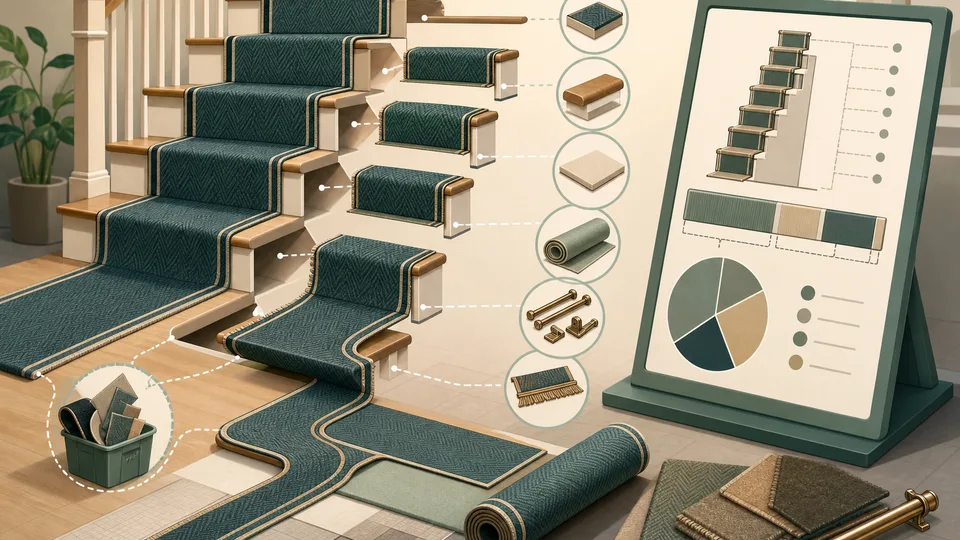
Stairs are the place where a flat flooring estimate starts to fall apart. A room floor is mostly one plane. A staircase has treads, risers, nosing, width, landings, turns, and fitting details. If you estimate it as a simple rectangle, the number may be neat but not very useful.
For early budgeting, I like to think of stair carpet as a repeated path: across the tread, down the riser, around the nosing, then on to the next step. A runner uses the same route but covers a narrower width. A full-width stair carpet covers more material and may need different finishing details.
The Stair Carpet Calculator estimates stair carpet or runner length, covered area, waste, underlay, and rough material cost from manual assumptions. It is a planning tool before you confirm measurements, product choice, and fitting details with a supplier or installer.
Why stairs need a separate estimate
The Flooring Calculator is useful for flat rooms because the area is usually length multiplied by width, plus waste. Stairs are different because the material bends over repeated shapes.
Each step has at least two surfaces: the tread you stand on and the riser facing forward. Many stairs also have nosing, where the carpet wraps around the lip of the step. Multiply that by the number of stairs and the missing detail becomes obvious.
A staircase also has visual and practical constraints. A runner may sit in the middle with exposed wood at each side. A full-width carpet may run wall to wall. A landing may need extra material beyond the straight stair run.
Measure tread, riser, and nosing
The core stair length estimate starts with the depth of each tread and the height of each riser. Add those together for one step, then multiply by the number of steps. If the carpet wraps around a nosing, include an allowance for that as well.
Do not guess the nosing if the product or fitting method makes it important. Some installations wrap differently from others, and some stair shapes are less straightforward than a simple straight run.
For a rough planning example, if tread plus riser plus nosing allowance totals 18 inches per step and there are 13 steps, the straight stair run needs about 234 inches, or 19.5 feet, before landing and waste allowance.
Runner width changes material and appearance
A runner is usually narrower than the staircase. That can reduce the covered area and material cost, but it also changes the finishing requirements. You may need rods, edge finishing, binding, or different fitting details depending on the chosen style.
Full-width stair carpet covers more surface. It may feel simpler in some layouts, but it still needs careful measurement because stairs are not a flat rectangle.
Enter the width you actually plan to cover. Do not use the full staircase width if the project is a runner, and do not use a runner width if the carpet will cover the whole step.
Landings and turns need their own allowance
Many staircase estimates go wrong at the landing. A straight flight with no landing is easier. Once there is a half landing, top landing, bottom landing, turn, or hallway connection, the extra material should be handled separately.
The calculator includes landing allowance so the stair run is not treated as the whole project. For complex stairs, split the job into clear sections and confirm the layout with an installer.
Do not force a winding staircase or multi-flight layout into a simple straight-run estimate and expect the result to hold. Use the estimate to understand the order of magnitude, then get proper measurement for the final order.
Waste is part of stair fitting
Waste on stairs covers trimming, fitting around edges, adjustment at the top and bottom, landing transitions, pattern matching, and room for error. Patterned carpet or striped runners can need more care because alignment is visible on every step.
A small waste allowance may be fine for a plain straight runner. A more complex staircase, patterned carpet, or landing-heavy job may need more. The calculator lets you add a waste percentage, but the right value depends on the product and layout.
If a supplier or fitter recommends a different allowance, use that over a generic guess. Their advice should reflect the actual product and staircase.
Underlay and accessories are separate from carpet length
Underlay, grippers, stair rods, thresholds, trims, adhesive, tape, and fitting accessories can change the shopping list. Some runner projects use visible rods or decorative finishes. Others are fitted more simply.
The carpet length estimate is only one line. The cost picture needs underlay and accessories too, especially if you are comparing a plain carpet, a bound runner, and a more decorative installation.
If the same project includes rooms as well as stairs, use the Carpet Roll Calculator for flat carpet roll planning and keep the stair calculation separate.
A worked example
Imagine a straight staircase with 13 steps. Each tread is 10 inches, each riser is 7 inches, and you allow 1 inch for nosing. One step therefore needs about 18 inches of run. Thirteen steps need 234 inches, or 19.5 feet.
Add a 3-foot landing allowance and the raw length becomes 22.5 feet. With 10% waste, the planning length becomes about 24.75 feet. If the runner is 30 inches wide, the covered area can be estimated from that length and width, while the cost depends on the material price and accessories.
This is not a final fitting plan, but it is much better than saying “it is just one staircase” and hoping the order is close.
Checklist before you trust the stair estimate
Before using the number for a budget, check the assumptions that stairs hide. Count the actual number of treads, not just the number of visible risers from memory. Measure tread depth and riser height consistently. Include nosing only in the way the carpet will actually wrap. Decide whether the project is a runner or full-width carpet, because width changes area and finishing details.
Then check landing allowance, waste, underlay, and accessories separately. A landing can add more material than expected, and a decorative runner may need binding, rods, or edge finishing that a plain budget does not include. Keep the estimate as a supplier conversation tool, not a final fitting instruction. The final order should reflect the actual staircase, product, and installation method.
One more practical check is whether the stair carpet connects to a hallway, landing, or room carpet. If the same material continues beyond the staircase, the stair estimate should not be isolated from the surrounding layout. If it stops at a threshold, the trim or transition detail needs its own allowance. That small boundary decision can change both material length and accessories.
What this estimate cannot replace
The calculator does not assess stair safety, choose fitting methods, place rods, plan turns, handle curved stairs, or replace professional measurement. It also does not decide whether a runner or full-width carpet is appropriate for a particular staircase.
Use the estimate to budget and prepare questions. Confirm the final length, width, waste, underlay, accessories, and fitting method before buying.
Stair carpet is one of those projects where the arithmetic is simple only after the shape is understood. Measure the repeated step path, handle landings separately, add waste deliberately, and keep the final order tied to the staircase you actually have.