
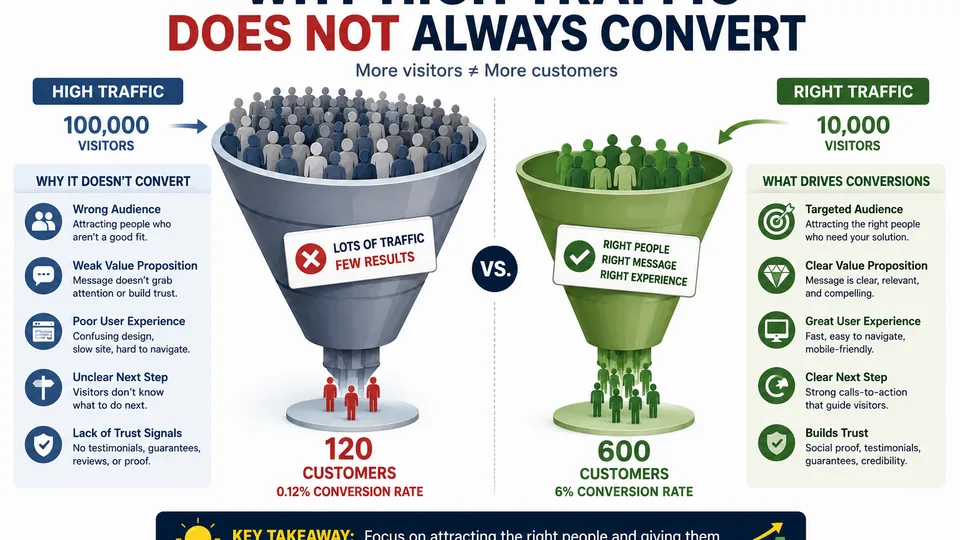
A founder once asked me to help him understand why his website was not generating leads despite what he described as strong traffic. He had invested heavily in content marketing over two years. Monthly visitors had grown from 3,000 to 28,000. Lead volume was 34 per month — barely above what it had been when traffic was a tenth of the size. The conversion rate had fallen from 1.1% to 0.12% as traffic grew. The content that was driving traffic was largely generic educational material — "what is X" and "how does Y work" articles that attracted people at the very beginning of the awareness journey, people who were nowhere near ready to evaluate his product. He had built an audience. He had not built a pipeline.
Traffic Quality Is Not Measured in Sessions
Google Analytics and similar tools measure visits, sessions, and pageviews. They do not measure intent, readiness to buy, or relevance to the offer. Two websites with identical monthly visitor counts can have radically different commercial outcomes if the composition of that traffic differs. A website where 70% of traffic comes from branded search — people actively looking for the specific product — will convert at 5–15 times the rate of a website where 70% of traffic comes from informational blog content. Understanding traffic composition — by source, by keyword intent category, by referral type — is more useful than tracking total volume. High traffic from low-intent sources is not a problem to celebrate; it is a signal that acquisition strategy needs reorienting toward sources with higher purchase intent.
The Intent Mismatch That Kills Conversion
Conversion fails when the offer presented does not match the stage the visitor is at. Someone who has just discovered that a category of product exists is not ready to start a free trial or request a demo. Someone actively comparing vendors is not interested in an introductory blog post. The landing experience must match the intent of the traffic arriving — which requires understanding what different traffic sources represent in terms of buyer journey stage, and ensuring that each source lands on content and calls to action appropriate to that stage. A paid search ad targeting "best project management software for small teams" should land on a comparison page with a clear product evaluation offer, not a homepage. The content marketing audience discovering "what is project management" should be offered further education, not immediately asked to convert to a product trial.
Why Growing Traffic First Is Often the Wrong Priority
Traffic investment scales the existing conversion rate, not a hypothetical better one. If a business is converting at 0.3%, spending more to double traffic doubles conversions but does not change the underlying economics. The same budget invested in improving conversion rate — through better landing pages, stronger calls to action, improved trust signals, reduced friction — applies to all existing and future traffic simultaneously. The sequencing principle: fix the funnel before scaling the traffic. A business converting at 0.3% that invests in conversion and reaches 1.2% has quadrupled effective marketing output without spending more on acquisition. Then, when traffic investment begins, it operates on a much more efficient base. Scaling traffic on a broken conversion funnel is expensive and slow. Scaling it on a well-optimised funnel is considerably more effective.
Diagnosing Where Visitors Drop Off
Conversion rate problems have specific causes that appear at specific points in the funnel. Visitors who leave the homepage immediately suggest a message mismatch — the page is not confirming what the traffic source promised. Visitors who read product pages but do not reach the checkout or sign-up suggest a pricing, trust, or feature concern that the page is not addressing. Visitors who begin the checkout or sign-up process but abandon it suggest friction in the form itself — too many fields, unexpected costs, confusing requirements. Session recording tools and heat maps show where attention is focused and where people exit. Funnel analytics show drop-off rates at each step. The right diagnostic tool depends on the hypothesis about where the problem lives. Running ads to more traffic before doing this diagnosis delays the fix and increases the cost of the underlying problem.
The Relationship Between Traffic Source and Conversion Rate
Conversion rates are not a property of a website — they are a property of the combination of traffic source and landing experience. The same product page can convert paid search traffic at 4% and social media traffic at 0.4%, because the intent and context of those audiences differ. A customer acquisition cost calculator that tracks conversion rate and acquisition cost by channel reveals which traffic sources are actually driving customers at acceptable cost and which are inflating session counts without commercial contribution. This channel-level view is more actionable than a blended site-wide conversion rate, because it tells you where to invest more and where to stop investing — rather than giving you a single number that averages together very different performing channels.
Content Strategy and Purchase Intent: Matching What You Publish to What You Sell
Content marketing's promise — attract an audience through useful content, convert that audience into customers — depends on a critical assumption: that the audience attracted by the content has some overlap with the audience who buys the product. When that overlap is small, content marketing drives traffic without driving revenue. The founder I described at the start had built an audience of people who were educating themselves about a complex topic. Many of them were curious, not buyers. A business selling a tool to working professionals in that space would need to produce content that those professionals actively search for when evaluating solutions — comparisons, case studies, implementation guides, ROI frameworks — not introductory explainers that attract people at the beginning of their learning journey who may never become buyers. Auditing content by the stage of the buyer journey it serves, and deliberately investing in content that serves the evaluation and decision stages, shifts the traffic composition toward higher-intent visitors over time.
The Relationship Between Landing Page Quality and Conversion Rate
Traffic source determines intent. Landing page quality determines whether that intent converts. A well-targeted paid search campaign driving high-intent traffic to a poor landing page will underperform a well-targeted campaign driving the same traffic to a well-designed page. Common landing page failures include: headlines that do not confirm what the traffic source promised (creating a mismatch that triggers immediate departure), unclear or buried calls to action, social proof that is weak or irrelevant to the target audience, pricing that is ambiguous or hidden behind a "contact us" barrier that adds friction, and page load times that exceed the two-second threshold above which mobile abandonment rises sharply. A systematic review of landing page quality — measured against these specific criteria rather than aesthetic preferences — often identifies conversion improvements that cost nothing to implement and apply immediately to all existing traffic. Before any campaign budget is increased, the landing experience that campaign traffic arrives at should be optimised to the point where conversion is limited by traffic quality, not page quality.
What to do next
Use the ideas above as a starting point — then connect them to your own numbers and related guides on Calc It Anything.
- Read the small business finance and growth guide for the wider cluster.
- Compare with What Is LTV:CAC and Why Every SaaS Founder Should Know It.
- Compare with What Is a Good LTV to CAC Ratio?.
- Run the relevant calculator on this site with your own inputs before making a decision.
Related reading
- small business finance and growth guide
- What Is LTV:CAC and Why Every SaaS Founder Should Know It
- What Is a Good LTV to CAC Ratio?
- Cost Per Acquisition Explained: When CAC Is Useful and When It Lies
Frequently asked questions
What LTV:CAC ratio is healthy for early-stage SaaS?
Many B2B SaaS teams aim for roughly 3:1 once gross margin and payback period are factored in, but consumer or low-margin models may need a higher ratio. Model your own payback months, not just the headline ratio.
Should I calculate LTV:CAC by channel or in aggregate?
Both. Company-wide ratios hide unprofitable channels subsidised by efficient ones. Segment by acquisition source and customer tier before reallocating spend.
Which lever usually moves LTV:CAC fastest?
Retention often beats cutting acquisition spend because churn sits in the LTV denominator. A one-point churn improvement can matter more than a double-digit CAC reduction.