
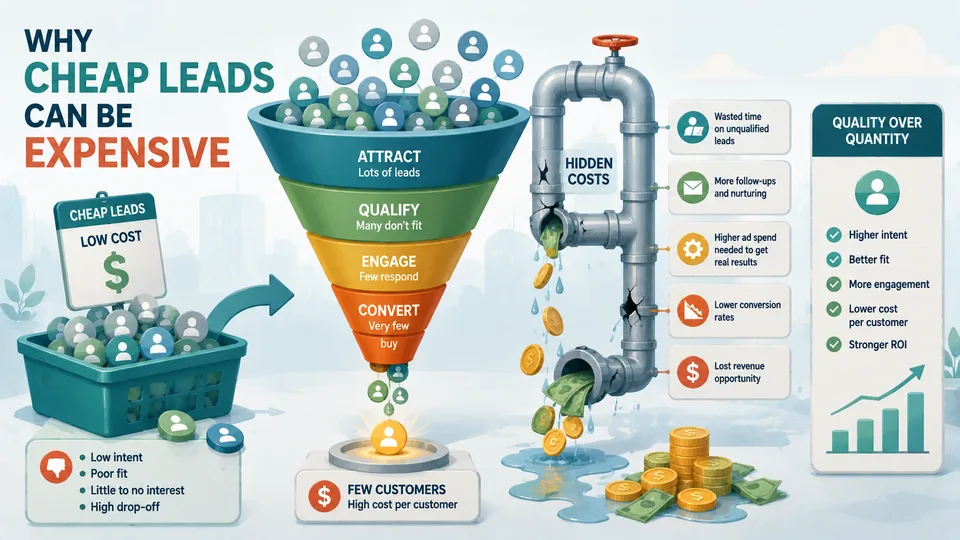
I ran a campaign once that generated leads at £4 each. My previous campaign had generated leads at £22 each. I felt very pleased with myself for the first few weeks. Then I looked at what the £4 leads were actually doing. Their close rate was 3%. The £22 leads had been closing at 22%. The cost per acquired customer from the cheap campaign was £133. From the expensive campaign it was £100. The campaign that looked five times more expensive per lead was 25% cheaper per customer — and the customers it produced had higher average order values too. I had optimised for the wrong metric and congratulated myself on results that were, in practice, worse.
Lead Cost Is Not Customer Cost
The distinction between cost per lead and cost per customer acquired is fundamental. Cost per lead is simply total spend divided by number of leads generated. Cost per acquisition is total spend divided by number of customers who actually buy. The relationship between them is mediated by close rate — the percentage of leads that convert to customers. A campaign generating £4 leads at 3% close rate produces customers at £133. A campaign generating £22 leads at 22% close rate produces customers at £100. Unless close rate is tracked and included in the calculation, lead cost data leads to systematically wrong decisions. A customer acquisition cost calculator that tracks both lead cost and close rate by channel prevents this mistake by showing the full cost picture rather than just the first step.
Why Cheap Traffic Often Has Low Intent
Broad-audience advertising generates cheap impressions and cheap clicks because it reaches many people who are not actually looking for what is being advertised. A display ad reaching people who have not searched for the product generates cheap traffic from people with no purchase intent. A search ad reaching people who have just searched for a specific product or solution costs more per click because the competition for that inventory is higher — but the traffic has self-identified as interested. The relevance gap between cheap and expensive traffic is often the entire explanation for the close rate gap. This does not mean expensive traffic is always better, but it does mean that traffic acquisition should be evaluated at the customer acquisition level rather than the click or lead level.
Lead Quality Signals: What to Track Beyond Close Rate
Close rate is the most important lead quality metric, but it is not the only one. Average order value of leads that convert tells you whether different lead sources are producing customers at different spend levels. Time to close reveals whether some lead sources require more sales effort to convert, which affects the true cost of acquisition. Customer retention rates by lead source tell you whether customers from different channels have different lifetime values. A channel that generates cheaper leads with lower close rates, lower average order values, and higher churn is substantially worse than it appears from the cost-per-lead figure alone. Building this attribution layer takes time and requires consistent tagging of lead sources through the CRM, but the insight it produces is the difference between effective and ineffective marketing investment decisions.
The Sales Time Cost That Does Not Appear in the Marketing Budget
Low-quality leads consume sales time without generating proportionate revenue. A sales team spending 60% of their time on leads that close at 3% is doing work that generates little return. The opportunity cost is the deals that could have been worked on with that time — whether from better-quality inbound leads or from outbound activity targeting more promising prospects. Sales time is a finite resource, and the cost of that time is real even when it does not appear in the marketing department's budget. Calculating the total acquisition cost of a lead source should include a realistic allocation of sales time: if each lead requires 2 hours of sales effort at a total employment cost of £35 per hour, that is £70 of cost that belongs in the acquisition calculation regardless of what channel the lead came from.
When Broad Reach Makes Sense Despite Lower Close Rates
High-volume, low-cost lead generation is not always inferior. In some business models — consumer products with low average order values, high-frequency purchases, or strong viral or referral mechanics — the economics can work even at low close rates. The key test is always the same: does total acquisition cost, including all costs associated with working those leads, produce customers at a cost that is justified by their lifetime value? If the answer is yes, the lead source is viable regardless of its close rate in isolation. Cheap leads are not inherently bad. They are bad when the close rate and customer value do not compensate for the true cost of converting them — including the sales time that never shows up on the marketing invoice.
The Hidden Cost of High-Volume, Low-Quality Lead Programmes
Lead generation programmes optimised for volume — high-spend content marketing, broad-audience paid social, lead magnet funnels that attract anyone in exchange for a free download — produce large numbers at low individual cost but create downstream costs that the lead generation budget never captures. Sales teams spending significant time on unqualified enquiries are not spending that time on qualified prospects. Customer success teams onboarding customers who were never a strong fit for the product face higher churn and more support demand. Marketing teams producing follow-up sequences for leads who will never buy are creating content and automation complexity without commercial return. The full cost of a high-volume low-quality lead programme includes the labour cost of processing leads that go nowhere — a cost that sits in operations and sales budgets and is rarely traced back to the acquisition channel that generated it. When this hidden cost is included, cheap leads frequently become the most expensive acquisition strategy available.
Improving Lead Quality Without Reducing Volume
The goal is not always to reduce volume in pursuit of quality — it is to improve the conversion rate of the leads you are generating by improving their relevance. Several approaches work in parallel. Tightening audience targeting on paid channels — using narrower demographic, behavioural, or intent-based filters — reduces volume but increases the proportion of leads who are genuinely prospects. Improving the qualifying questions on lead capture forms — asking about budget, timeline, and specific need rather than just name and email — self-selects for people with real intent and filters out browsers. Using lead scoring to rank enquiries by their similarity to the profile of customers who have converted and retained well helps the sales team prioritise time toward the leads with the highest probability of becoming good customers. None of these measures are costless — they require data, testing, and ongoing management — but the economics of improving lead quality are almost always better than the economics of increasing raw volume while holding quality constant.
The instinct to celebrate cheap leads is understandable — lower cost feels like better performance. But acquisition efficiency is measured at the customer level, not the lead level. A lead that costs £4 and closes at 3% is not cheaper than a lead that costs £22 and closes at 22%. It is more expensive, less likely to produce a good customer, and more costly to process. Knowing the difference requires tracking the full journey — from lead source to customer to revenue — rather than stopping the measurement at the point where the cost is lowest and the conversion is yet to happen.
What to do next
Use the ideas above as a starting point — then connect them to your own numbers and related guides on Calc It Anything.
- Read the small business finance and growth guide for the wider cluster.
- Compare with What Is LTV:CAC and Why Every SaaS Founder Should Know It.
- Compare with What Is a Good LTV to CAC Ratio?.
- Run the relevant calculator on this site with your own inputs before making a decision.
Related reading
- small business finance and growth guide
- What Is LTV:CAC and Why Every SaaS Founder Should Know It
- What Is a Good LTV to CAC Ratio?
- Cost Per Acquisition Explained: When CAC Is Useful and When It Lies
Frequently asked questions
What LTV:CAC ratio is healthy for early-stage SaaS?
Many B2B SaaS teams aim for roughly 3:1 once gross margin and payback period are factored in, but consumer or low-margin models may need a higher ratio. Model your own payback months, not just the headline ratio.
Should I calculate LTV:CAC by channel or in aggregate?
Both. Company-wide ratios hide unprofitable channels subsidised by efficient ones. Segment by acquisition source and customer tier before reallocating spend.
Which lever usually moves LTV:CAC fastest?
Retention often beats cutting acquisition spend because churn sits in the LTV denominator. A one-point churn improvement can matter more than a double-digit CAC reduction.