
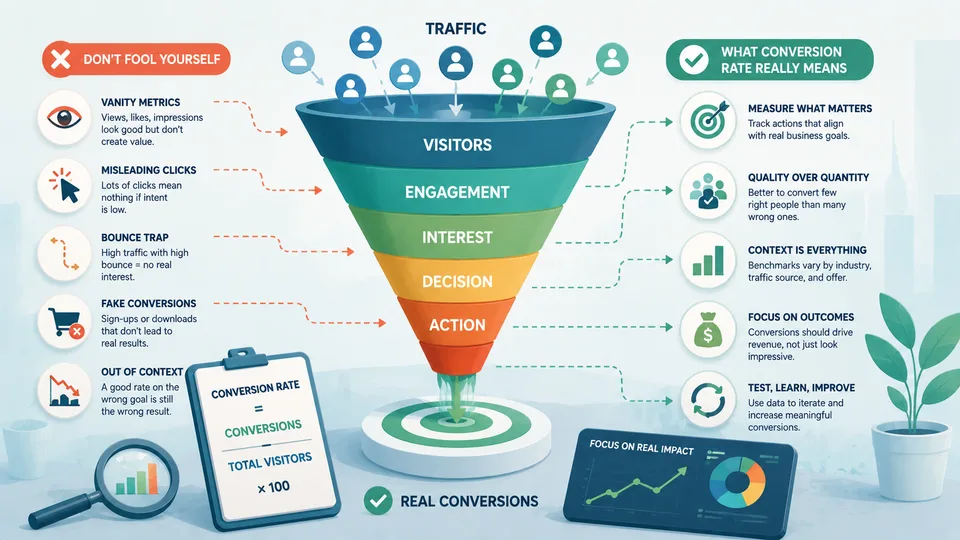
The first time a client showed me their Google Analytics data they were excited about the traffic numbers. Forty thousand visitors per month, growing 20% year on year. When I asked how many had become customers, they were not sure. It took a few minutes to find the conversion tracking and when we did, the rate was 0.3%. Forty thousand visitors were generating 120 conversions per month. A competitor they mentioned was getting half the traffic but had a conversion rate of 2.1% — which meant they were acquiring 420 customers per month on half the audience. The traffic comparison was irrelevant. The conversion gap was the entire story.
What Conversion Rate Is and Why It Multiplies Everything
A conversion rate is the percentage of people at a given stage of a process who take the desired next action. Website visitors who fill in a contact form. Trial users who upgrade to paid. Leads who become customers after a sales call. The specific conversion event depends on the business model and the stage of the funnel being measured. Conversion rate is multiplicative: it applies to whatever volume flows through the funnel above it. Doubling traffic at a 1% conversion rate doubles conversions. Doubling the conversion rate to 2% with unchanged traffic also doubles conversions — but typically at a fraction of the cost of acquiring twice as much traffic. This is why conversion rate optimisation is often the highest-ROI marketing activity once a business has established meaningful traffic or pipeline volume.
The Funnel Has Multiple Conversion Points — Each One Matters
Most businesses think of conversion rate as a single figure when it is actually a sequence. Visitor to lead. Lead to qualified opportunity. Opportunity to proposal. Proposal to customer. Each stage has its own conversion rate, and the overall funnel conversion rate is the product of all of them. If 1,000 visitors become 50 leads (5%), 50 leads become 20 opportunities (40%), and 20 opportunities become 8 customers (40%), the overall visitor-to-customer conversion rate is 0.8%. Improving any single stage improves the overall rate. The most valuable stage to improve is usually the one with the lowest conversion rate relative to what is typical for the industry or business type — that is where the largest gap between current and potential performance is likely to exist.
What Drives Conversion — and What Does Not
Conversion is driven by the match between what visitors expect to find and what they actually find — relevance — and the quality of the experience that follows. A paid ad promising "free project management tool" that lands on a page requiring credit card details will convert badly because the offer does not match the expectation. A testimonial-rich landing page with a simple sign-up form that delivers on its headline promise will convert well. Common conversion killers include: slow page load times (each additional second of load time reduces conversion by 4–7% on mobile), friction in the sign-up or checkout process (additional form fields, account creation requirements, unclear pricing), poor trust signals (no reviews, no security badges, unfamiliar brand), and mismatched messaging between the acquisition channel and the landing page. Identifying the specific cause of low conversion requires testing rather than assumption.
Industry Benchmarks: Useful for Context, Dangerous as Targets
E-commerce sites typically convert at 1–3%. B2B SaaS free trials convert to paid at 15–25%. Landing pages for lead generation average 2–5%. These benchmarks are useful for understanding whether a conversion rate is broadly reasonable or clearly problematic. They are less useful as targets, because the appropriate conversion rate depends entirely on the traffic source and the offer. Cold traffic from social media ads converts at a fraction of the rate of warm traffic from email lists. High-intent search traffic converts better than display ad traffic. A conversion rate of 1% from cold paid traffic is often good; a conversion rate of 1% from a warm email list to existing customers is usually poor. Benchmark comparisons are most meaningful when the traffic source and offer type are comparable.
Testing Conversion Rate Improvements: The Right and Wrong Way
Conversion rate changes are best validated through controlled testing rather than observation. Changing a page element and then observing an increase in conversion over the following weeks cannot tell you whether the change caused the improvement or whether other factors — seasonal demand, a new marketing campaign driving better-quality traffic, a competitor going offline — were responsible. A/B testing — running two versions simultaneously with traffic randomly distributed — controls for these external variables and gives you a statistically reliable read on whether the change had an effect. Running A/B tests requires sufficient traffic to generate statistical significance within a reasonable timeframe: a low-traffic page may need months to produce a conclusive result. Starting with the highest-traffic pages and the most impactful elements — headline, primary call to action, pricing display — generates usable results faster than testing small design details on low-traffic pages.
When Fixing Conversion Is More Urgent Than Growing Traffic
The decision of where to invest — more traffic or better conversion — depends on the current state of the funnel. If conversion rate is below 0.5% on a product or service with established market demand, the funnel has a structural problem that more traffic will not fix. Spending on acquisition while conversion is broken is pouring money into a process that loses most of it before generating value. Fixing conversion first — to a level that reflects the quality of the offer and the relevance of the traffic — creates a foundation on which traffic investment compounds properly. Once conversion is working, the revenue impact of each additional unit of traffic is calculable and investment decisions become straightforward.
Micro-Conversions: The Leading Indicators of Final Conversion
A macro-conversion — a purchase, a signed contract, a completed application — is the outcome that matters most. Micro-conversions are the smaller steps that lead there: clicking a product image, viewing a pricing page, starting a checkout, adding an item to a wishlist, watching more than 50% of a video. Tracking micro-conversions reveals where visitors are engaged and where they are dropping off before reaching the macro-conversion event. A visitor who views the pricing page three times but never initiates the sign-up is expressing significant interest; the barrier is not awareness of the product but something specific about the offer, the pricing structure, or the risk of committing. Micro-conversion data makes the funnel legible in a way that macro-conversion rates alone cannot. Understanding which micro-conversions predict macro-conversion — and which are engagement without intent — requires analysis of historical patterns. But once those leading indicators are identified, optimising for them is faster and more actionable than waiting for macro-conversion rates to move. A customer acquisition cost calculator used alongside conversion data by channel tells you not only where visitors convert best, but where the economics of that conversion make acquisition most efficient.
Conversion rate is ultimately a measure of how well the business is communicating its value to the people it is reaching. Traffic is the audience. Conversion is the portion of that audience who are convinced enough to act. The gap between those two numbers is where most of the leverage in a digital business lives — and unlike traffic, improving conversion does not require spending more money to reach more people. It requires understanding more clearly why the people already arriving are not taking the action you want, and removing the barriers that stand in their way.
What to do next
Use the ideas above as a starting point — then connect them to your own numbers and related guides on Calc It Anything.
- Read the small business finance and growth guide for the wider cluster.
- Compare with What Is LTV:CAC and Why Every SaaS Founder Should Know It.
- Compare with What Is a Good LTV to CAC Ratio?.
- Run the relevant calculator on this site with your own inputs before making a decision.
Related reading
- small business finance and growth guide
- What Is LTV:CAC and Why Every SaaS Founder Should Know It
- What Is a Good LTV to CAC Ratio?
- Cost Per Acquisition Explained: When CAC Is Useful and When It Lies
Frequently asked questions
What LTV:CAC ratio is healthy for early-stage SaaS?
Many B2B SaaS teams aim for roughly 3:1 once gross margin and payback period are factored in, but consumer or low-margin models may need a higher ratio. Model your own payback months, not just the headline ratio.
Should I calculate LTV:CAC by channel or in aggregate?
Both. Company-wide ratios hide unprofitable channels subsidised by efficient ones. Segment by acquisition source and customer tier before reallocating spend.
Which lever usually moves LTV:CAC fastest?
Retention often beats cutting acquisition spend because churn sits in the LTV denominator. A one-point churn improvement can matter more than a double-digit CAC reduction.