
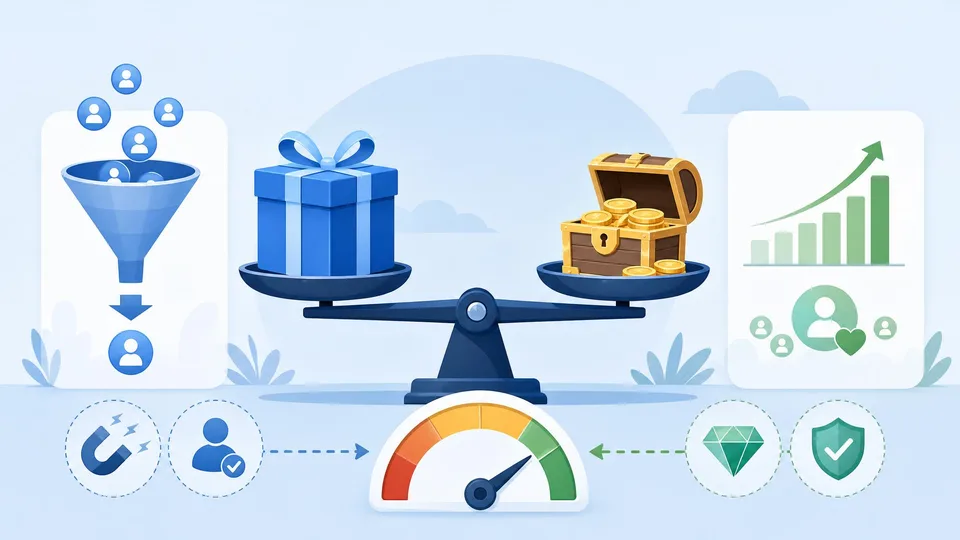
Freemium is a distribution strategy with a maths test — not a moral stance on free software.
It works when free users are cheap to serve, conversion is high enough, and paid LTV funds the rest. It fails when teams treat free growth as progress while unit economics stay negative.
It belongs in our saas metrics churn startup finance guide, alongside why most freemium models fail and how many free users to make money. Use the freemium viability calculator when you want to model your own numbers.
Pros and Cons
The genuine advantages of freemium:
Lower friction acquisition: No payment requirement at the start of the relationship removes the largest barrier to trial. Products that require a credit card to try consistently see lower trial volume than those that do not, regardless of how good the product is. Freemium compresses the path from discovery to active usage, which is valuable in competitive markets where getting users to experience the product is the primary challenge.
Organic growth: Free users who find value in the product talk about it. In B2B contexts, a free tier often enables a single champion to introduce the product to their organisation, building internal familiarity before a paid conversion or enterprise deal. Slack, Figma, and Notion all used this mechanism — individual free users created organisational exposure that converted to team or company subscriptions.
Product feedback volume: A large free user base generates usage data and feedback at a scale that paid-only products rarely achieve. This can meaningfully accelerate product development in the early stages.
The genuine disadvantages:
Infrastructure cost at scale: Free users consume real resources. Storage, compute, bandwidth, customer support — all of these cost money, and none of it is recovered from non-paying users. At scale, the infrastructure cost of the free tier can exceed the revenue from the paid tier if conversion rates are low.
Support burden: Free users generate support requests. If the support model is not carefully tiered — deflecting free users to documentation and community while reserving human support for paying customers — the cost of supporting non-paying users can be substantial.
Conversion psychology: Users who have used a product for free develop an expectation of free. The upgrade request can feel like a price increase on something they already have, which creates more friction than a paid trial converting to a subscription. This perception problem is why freemium conversion rates are consistently lower than equivalent paid trial conversion rates.
Conversion Rates
Industry conversion benchmarks for freemium — the percentage of free users who convert to a paid plan — are sobering: 2% to 5% is typical for consumer products. B2B products with strong network effects or workflow integration achieve 5% to 10%. Products with exceptional product-market fit and a clear free-to-paid value gap reach 15% to 25%, but this is the high end of documented outcomes, not the average.
The practical implication: if your infrastructure and support cost per free user is £2 per month and your conversion rate is 3%, you need each converted user to generate enough LTV to cover both their own cost and the cost of the 32 unconverted users who also used £2 of resources per month. At a £20/month paid plan with 70% gross margin and 18-month average lifetime: LTV = £252. Cost of the 33 users in the cohort (1 paid + 32 free): 33 × £2 × 18 = £1,188. The paid user's LTV does not cover the cohort cost.
The Freemium Viability Calculator models this precisely. Enter your free user cost, conversion rate, paid plan revenue, gross margin, and average customer lifetime, and it calculates whether the model is viable — and what conversion rate is required to reach viability at your current cost structure.
Risks
The most significant freemium risks beyond unit economics:
Feature cannibalisation: If the free tier is too generous, it removes the incentive to upgrade. Defining the value gap between free and paid is one of the most difficult product decisions in freemium — too narrow and conversion suffers; too wide and free users do not get enough value to stay and refer others.
Competitor undercutting: Once a freemium model is established, a well-funded competitor can offer a more generous free tier, pulling your free user base without immediate revenue impact on you but significant strategic damage to your acquisition pipeline.
Unit economics that look acceptable at small scale and deteriorate at large scale: As the free user base grows, infrastructure and support costs scale with it. Conversion rates often decline as the product reaches less engaged users in the growth phase. The economics that worked at 10,000 users frequently break at 1,000,000.
Worked example: pros and cons on one product
Pros: 8,000 free sign-ups/month at £0.40 marginal cost; word-of-mouth lowers blended CAC to £95 versus £140 on paid-only trials. Product feedback accelerates roadmap.
Cons: 2.8% convert to £19/month at 70% margin. Contribution per 100 free users: 2.8 × £13.30 = £37.24 revenue vs £40 cost — underwater. Support tickets from free users add £900/month.
Verdict: model is not good yet. Options: raise price to £29, cap storage on free, or shift to 14-day trial. Calculator shows 5.1% conversion needed at current costs.
Check results in the cac calculator and see what is a good ltv cac ratio for related guidance.
What to do next
- List true pros/cons for your cohorts, not industry slogans.
- Run freemium viability with your cost and price.
- Compare trial-only CAC and conversion for one quarter.
- Tier support: community for free, humans for paid.
- Set kill criteria if conversion stays below break-even two quarters.
This article is for general planning and education — not professional financial, tax, or legal advice. Figures are illustrative; check current terms and your own numbers before acting.
Frequently asked questions
Is freemium better than free trial?
Freemium when viral loop and low marginal cost; trial when value is obvious in 7–14 days and support is heavy.
Do investors expect freemium?
They expect coherent unit economics. Model choice must match data.
Can freemium work with ads?
Possible in consumer, rare in B2B SaaS. Ads rarely cover high support and infra costs alone.
How generous should free be?
Enough to reach first value; not enough to complete core job forever.
Should we charge annually only?
Annual improves cash and retention; freemium still needs monthly conversion tracking.