
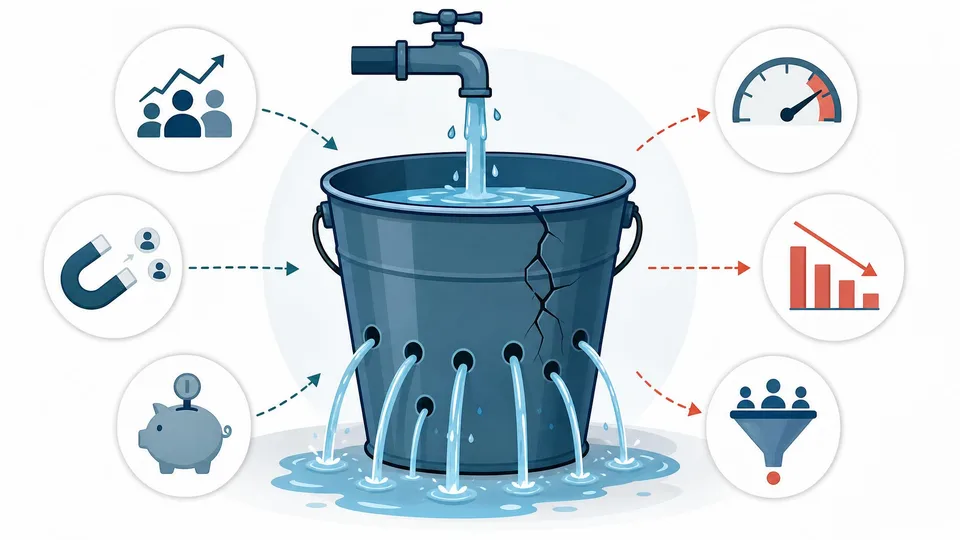
Freemium fails when free users cost real money and too few convert before runway runs out.
Failure is rarely product quality alone. It is conversion too low, free tier too generous, infrastructure cost scaling faster than revenue, or pricing paid plans below what cohort economics require.
It belongs in our saas metrics churn startup finance guide, alongside is freemium a good business model and how many free users to make money. Use the freemium viability calculator when you want to model your own numbers.
Low Conversion
The most common cause of freemium failure is a conversion rate that is too low to cover the cost of the free tier. Industry benchmarks of 2% to 5% are averages that include both successful and failed products. They are not targets — they are descriptions of what has been observed, including many businesses that were not profitable at those rates.
Low conversion has specific causes, each requiring a different fix:
No clear upgrade trigger: If free users cannot identify a specific, compelling reason to pay — a feature they actively want, a limit they are consistently hitting, a workflow that would meaningfully improve with the paid version — they will not upgrade. The upgrade decision requires a positive motivation, not just an arbitrary paywall. Products that charge for storage, seats, advanced analytics, or integrations with widely-used tools typically convert better than those that simply restrict core functionality arbitrarily.
Free tier too generous: A free tier that provides 80% of the product's value at 0% of the cost leaves no compelling reason to upgrade for the majority of use cases. Many freemium products fail here — the free offering is genuinely good enough for most users, and the paid tier adds value that is real but not compelling enough to justify the switch from free. The line between "generous enough to attract users" and "too generous to convert them" is narrow and must be tested rather than assumed.
Weak onboarding to paid value: Users who never experience the paid features do not convert to them. If the upgrade path is not surfaced at the right moments — when a user is hitting a free tier limit, when they are engaging most actively, when they are performing the workflow where paid features would help — the conversion rate suffers from missed opportunity rather than actual unwillingness to pay.
Use the Freemium Viability Calculator to find the conversion rate your business needs to reach viability. If the required rate is significantly above industry benchmarks, the product design or pricing structure requires adjustment before growth investment is made.
High Costs
The second failure mode is infrastructure and operational costs that scale faster than conversion revenue. This often does not become apparent until the free user base is large, at which point the cost structure is embedded and the conversion rate has settled below what is required.
Storage-heavy applications — file sharing, video hosting, design tools — face particularly acute free tier cost challenges because storage costs scale directly with user-generated content, which grows regardless of whether the user ever converts. A free user who uploads 10GB of files per month costs the same in storage as one who uploads nothing — zero. The economics of "unlimited free storage" look fundamentally different at 1 million users than at 10,000.
The businesses that run sustainable freemium models at scale have either very low marginal cost per additional free user (pure software with no data intensity), hard limits on free tier resource consumption (storage caps, API rate limits, seat restrictions), or conversion rates that are structurally high because the product is deeply embedded in a valuable workflow.
Poor Monetisation
The third failure mode is pricing the paid tier incorrectly relative to the value delivered. Freemium products that charge too little for the paid tier — either because they underestimated what users will pay or because they set prices before understanding the full value of their product — leave significant revenue on the table that could cover the cost of the free tier several times over.
Freemium conversion rates are generally not elastic to small price changes — a user who sees enough value to pay £10/month will typically pay £18/month. The additional £8/month per converted user may be the margin that makes the model viable or not. Many freemium businesses that fail are not failing because conversion is too low — they are failing because the revenue per converted customer is insufficient, and a price increase would resolve it.
The diagnostic test: calculate break-even paid plan price at your current conversion rate and free user cost. If break-even price is above your current price but below what comparable users are demonstrably willing to pay, the fix is pricing — not conversion optimisation.
Worked example: when 3% conversion is not enough
A tool spends £1.80 per free user per month on hosting and support. Paid plan is £22/month at 72% gross margin (£15.84 contribution). Conversion is 3%. Per 100 free users, monthly free-tier cost is £180; paid users contribute 3 × £15.84 = £47.52. Net: −£132.48 per cohort per month before sales and marketing.
Break-even conversion at these numbers: £180 / £15.84 ≈ 11.4 paid users per 100, or 11.4% conversion — far above typical consumer freemium averages. The founder assumed scale would fix economics; scale widened the loss.
Fixes: cut free-tier cost (limits, caching, self-serve support), raise price, tighten free tier, or move to trial-led paid motion. The freemium viability calculator shows required conversion for your actual inputs.
Check results in the burn rate calculator and see what is a good ltv cac ratio for related guidance.
What to do next
- Measure cost per free user and paid contribution margin.
- Calculate required conversion for break-even.
- Audit free tier generosity against upgrade triggers.
- Model scale scenarios — conversion often falls as audience broadens.
- Compare freemium vs time-limited trial on the same CAC.
This article is for general planning and education — not professional financial, tax, or legal advice. Figures are illustrative; check current terms and your own numbers before acting.
Frequently asked questions
Is low conversion always the problem?
Often, but high infrastructure cost or underpriced paid tiers can break the model even at average conversion.
Can freemium work for B2B?
Yes, when free users drive team adoption and expansion revenue is strong. B2B still needs viable conversion or clear enterprise upsell paths.
Should we remove the free tier?
Sometimes a 14-day full-feature trial converts better. Test before carrying a large free population.
Do viral products get a pass on unit economics?
Virality lowers CAC but does not eliminate serving cost. Slack-like motions still hit conversion maths eventually.
How often should we revisit free-tier limits?
At least quarterly once you have cohort cost data. Limits should track marginal cost per active free user.