
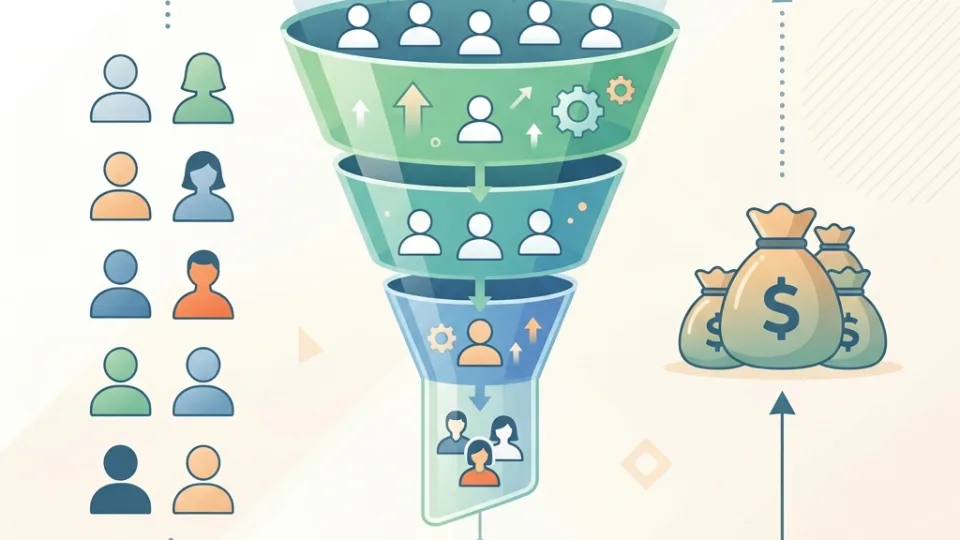
The question is not headcount — it is whether your conversion and margin cover free-tier cost at scale.
Every free user is a small invoice for hosting, support, and data. Paid users must fund their own cohort plus the free majority.
It belongs in our saas metrics churn startup finance guide, alongside is freemium a good business model and why most freemium models fail. Use the freemium viability calculator when you want to model your own numbers.
Conversion Maths
The basic freemium maths starts with cost coverage. If serving each free user costs £1.50 per month in infrastructure and support, and your conversion rate is 4%, each cohort of 100 free users costs £150 per month to serve and produces 4 paying customers.
For the model to be viable, those 4 paying customers must generate enough revenue to cover both their own cost of service and the £150 monthly cost of serving the 100-user cohort. If the paid plan is £25/month at 70% gross margin, monthly gross profit from 4 customers is £70. Monthly cost of the free tier: £150. Net monthly position per 100-user cohort: -£80. The model destroys value at this conversion rate and cost structure.
To break even at the same costs, you need: (paid plan × gross margin × conversion rate) = (free user cost × total users). Solving for conversion rate: £25 × 0.70 × r = £1.50. r = 1.50 / 17.50 = 8.6%. You need an 8.6% conversion rate to break even — more than double the typical benchmark of 4%.
The Freemium Viability Calculator runs this calculation for your specific numbers. Enter your cost per free user, conversion rate, paid plan price, gross margin, and average customer lifetime, and it shows whether the model is currently viable and the conversion rate required to reach viability at your current cost structure.
Revenue Breakdown
Freemium revenue comes almost entirely from the paid tier. The free tier generates indirect revenue only — through referrals, network effects, and enterprise pipeline — all of which are real but difficult to quantify. For financial modelling purposes, revenue = paid users × average revenue per paid user.
The revenue calculation that surprises most freemium founders: the revenue per free user registered is very small. If you have 50,000 free users, 3% convert to paid at £20/month: 1,500 paying customers generating £30,000 MRR. Revenue per registered free user: £0.60/month. If serving each free user costs £1/month, the free tier is a cost centre, not a growth engine, unless the indirect effects (referrals, enterprise pipeline) can be quantified and are genuinely large enough to justify the investment.
Successful freemium businesses typically have one of three structural advantages that make the economics work: very low free tier infrastructure cost (the marginal cost of an additional free user approaches zero), high conversion rates driven by a clear and compelling upgrade trigger, or strong network effects that make the free tier a genuine acquisition channel with measurable referral value.
Scaling
Freemium economics change as the product scales, and not always in the direction founders assume. Three dynamics affect the model at scale:
Conversion rate compression: Early free users are typically early adopters — highly motivated, highly engaged, and more likely to convert. As the product reaches a broader audience through growth, the average engagement level and conversion intent of free users tends to decline. A product that converts 6% of its first 10,000 free users may convert only 3% of the next 90,000. Modelling conversion rates as stable across scale systematically overstates future revenue.
Support cost scaling: Free users generate support volume that scales with user count. The absolute cost of supporting a large free user base can be significant even at low per-user cost. Deflection systems — in-app help, documentation, community forums — reduce but do not eliminate this cost, and building them requires investment that must be accounted for in the model.
Infrastructure cost curves: Cloud infrastructure costs often have non-linear cost curves — unit costs are higher at small scale, fall as volume grows, then can rise again as usage patterns become more intensive. The per-user infrastructure cost at 100,000 users may be lower than at 10,000, which improves the economics at scale. Modelling infrastructure costs with realistic scale assumptions rather than a flat per-user rate produces a more accurate forward view.
Worked example: users needed at 4% conversion
Paid: £30/month, 68% margin → £20.40 contribution. Free cost: £1.10/user/month. Conversion 4%. Per 1,000 free users: cost £1,100; paid users 40; contribution £816. Net −£284/month.
To break even at same economics: need contribution ≥ £1,100 → 54 paid users → 5.4% conversion from 1,000 free, or 540 paid from 10,000 free.
At 10,000 free users and 4% conversion they need either 1,350 more paid users (impossible without more free) or lower free cost / higher price. Calculator solves required conversion instantly.
Founders often discover the gap only after a fundraise slide shows user growth while cash burn accelerates — run the maths before scaling paid acquisition to free sign-ups.
Check results in the ltv vs cac breakeven calculator and see what is a good ltv cac ratio for related guidance.
What to do next
- Measure cost per active free user monthly.
- Track conversion by cohort, not blended.
- Model break-even users in freemium viability calculator.
- Stress-test at 2× and 5× free base.
- Set max free tier limits if maths fail.
This article is for general planning and education — not professional financial, tax, or legal advice. Figures are illustrative; check current terms and your own numbers before acting.
Frequently asked questions
Does more free users always help?
Only if marginal cost is near zero and conversion holds. Otherwise scale deepens losses.
What is a good revenue per free user?
Paid contribution × conversion rate must exceed free cost — often £0.50–£2+ depending on price.
Should we cap sign-ups?
If economics break, cap or waitlist until conversion improves.
How does enterprise fit?
Free seats may land enterprise deals — model pipeline value separately, not as excuse to ignore unit economics.
Can we monetise free with ads?
Only if ad ARPU exceeds cost; rare for tooling products.