
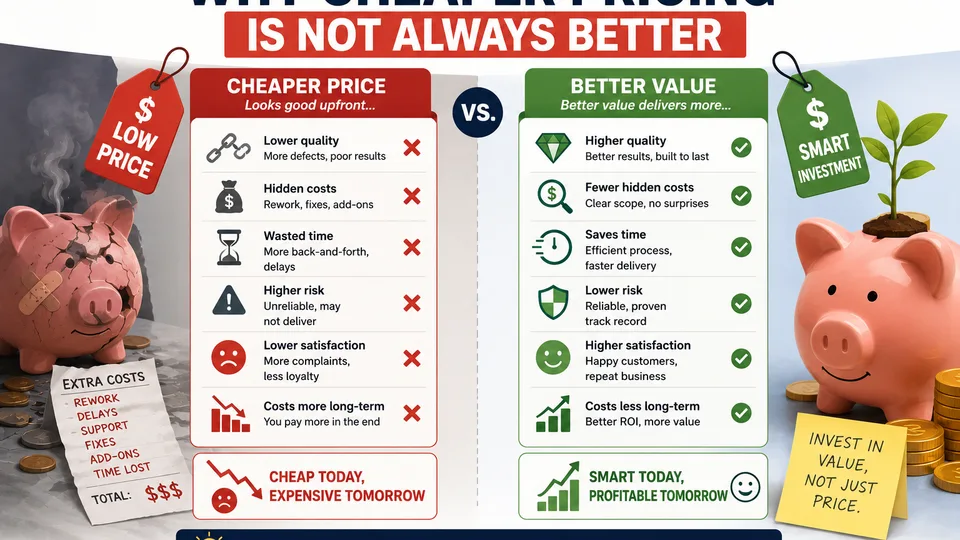
I watched a small software business drop its subscription price by 30% in response to a competitor entering their market at a lower price point. The logic was straightforward: protect market share by matching the price signal. Twelve months later, the business had more customers than before — and was making significantly less money. The extra customers had not compensated for the reduced margin. More importantly, the competitor had not taken their existing customers. The price cut had been a response to a threat that had not materialised, and it had permanently reduced the business's economics. When they tried to raise prices back toward the original level, they hit resistance from a customer base that had been acquired specifically on the basis of the lower price.
The Margin Mathematics of Discounting
Price reductions have a disproportionate impact on profitability because they reduce revenue without reducing costs. A product with a 40% gross margin and a £100 selling price generates £40 in gross profit. A 20% price reduction takes the selling price to £80. If costs are unchanged at £60, gross profit is now £20 — a 50% reduction in profit from a 20% reduction in price. To recover the same total gross profit as before the price cut, unit volume must double. In most markets, a 20% price reduction does not double volume. Price elasticity of demand — the relationship between price changes and volume changes — varies enormously by product, market, and competitive context, but a doubling of demand from a 20% price cut is unusual outside of commodity markets. A profit margin calculator that models this effect in your specific cost structure shows exactly how much additional volume is needed to break even on a price reduction.
What Cheap Pricing Signals to Buyers
Price is a quality signal. In markets where buyers cannot easily evaluate quality before purchase — professional services, software, complex products, anything with long decision cycles — price is used as a proxy for capability. A management consultant charging half the market rate does not attract twice as many clients; they attract clients who could not afford the market rate, which often correlates with lower ability to pay and higher demands on time. A SaaS product priced below market may attract users who are unwilling to invest in proper tools and expect to get something-for-nothing — a customer segment with higher churn, lower expansion revenue, and higher support costs. The race to the bottom in pricing is real, but the customers at the bottom are often not the customers that sustain a healthy business.
The Competitive Response That Often Works Better Than Price Matching
When a competitor enters at a lower price point, the first question worth asking is: who are they actually competing for? A low-price competitor typically serves price-sensitive buyers who were less valuable to the incumbent anyway. The incumbent's existing customers — who are paying the higher price and have not left — are demonstrating that they value something other than the lowest price. Protecting those customers means reinforcing whatever it is they value: reliability, quality, customer service, integration depth, industry expertise. Price matching to retain customers who were not leaving, while giving up margin on every customer, is often the worst available response. Maintaining price while investing the protected margin in the product and service quality that justifies it is usually better for the long-term business.
When Pricing Lower Is the Right Strategy
There are situations where lower pricing is genuinely strategic rather than defensive. Penetration pricing — entering a market at below-market price to build share quickly — is appropriate when network effects, switching costs, or scale advantages mean that a larger installed base creates durable competitive advantage that justifies the near-term margin sacrifice. Segment targeting — offering a genuinely simpler, cheaper product to a market segment that is currently unserved by premium options — is a real market opportunity, not a race to the bottom, when the segment has sufficient size and the lower-cost product can be delivered at healthy margins. The distinction between strategic low pricing and reactive discounting is purpose: is the pricing decision driving toward a specific market position, or is it a response to competitive pressure that has not been thought through?
Price Anchoring and the Psychology of What Feels Cheap
Perceived value is relative. A product that is the cheapest option in a comparison feels cheap. The same product positioned as the mid-tier option — below a premium alternative and above a basic one — feels reasonable. Price anchoring, the practice of presenting a higher reference price alongside the actual price, is widely used in retail and subscription pricing for this reason. A subscription plan priced at £49 per month looks expensive in isolation. Presented next to an enterprise plan at £199 per month, it looks like the sensible choice. This is not manipulation but communication: it provides context that helps buyers understand where the product sits in the market. A markup calculator can help you understand what pricing tiers are sustainable at your cost structure before designing the packaging.
The Price Expectation Problem With Discounted Customer Cohorts
When a business acquires a significant cohort of customers at a discounted price — through a launch promotion, a seasonal sale, or a competitive response — those customers form their price reference point at the discounted level. Subsequent price increases are experienced as losses relative to their reference point, even when the new price represents fair value. The psychological resistance to price increases is stronger than the resistance to paying the full price initially, because people weight losses more heavily than equivalent gains. This means businesses that have been through periods of significant discounting face a structural problem: their customer base expects prices that the business cannot sustain at healthy margins, and raising them carries higher churn risk than they would face if those customers had been acquired at full price. Managing this requires segmenting customers by acquisition cohort, understanding which cohorts are price-sensitive versus value-driven, and taking a graduated approach to price realignment that gives high-value customers adequate notice and rationale.
Value-Based Pricing: Charging What the Outcome Is Worth
The most durable pricing strategy is not market-rate, not cost-plus, and not discounted — it is value-based. Value-based pricing sets price in relation to what the outcome is worth to the buyer, rather than what it costs to produce or what competitors charge. A consultant who helps a client save £500,000 in operational costs has delivered £500,000 in value. Pricing at £50,000 for that work — 10% of the value delivered — is defensible and profitable regardless of what the hours cost or what a less experienced consultant would charge. The barrier to value-based pricing is not the concept but the execution: it requires understanding the client's business well enough to quantify the value of the outcome, and it requires confidence to price against that value rather than defaulting to a comfortable hourly rate. Businesses that develop this capability outgrow the competitive dynamics of commodity pricing entirely, because they are no longer operating in a market where "cheaper" is a relevant comparison.
What to do next
Use the ideas above as a starting point — then connect them to your own numbers and related guides on Calc It Anything.
- Read the small business finance and growth guide for the wider cluster.
- Compare with How to Calculate Your True Hourly Rate as a Freelancer.
- Compare with How to Price Freelance Work Without Guessing.
- Run the relevant calculator on this site with your own inputs before making a decision.
Related reading
- small business finance and growth guide
- How to Calculate Your True Hourly Rate as a Freelancer
- How to Price Freelance Work Without Guessing
- Why You're Overestimating Your Freelance Income
Frequently asked questions
Should freelancers price hourly or on retainers?
Hourly work suits variable scope; retainers stabilise income when delivery is predictable. Many freelancers mix both — hourly for discovery, retainer for ongoing work once scope is clear.
How much buffer should irregular income earners hold?
A practical target is three to six months of essential expenses in cash, plus a separate tax pot if you are self-employed. Build the buffer before aggressive investing or lifestyle upgrades.
What is the biggest freelance pricing mistake?
Quoting from gut feel without annualising billable days, admin time, tax, and unpaid gaps. Use your effective hourly rate after all costs, not the number on the invoice.