
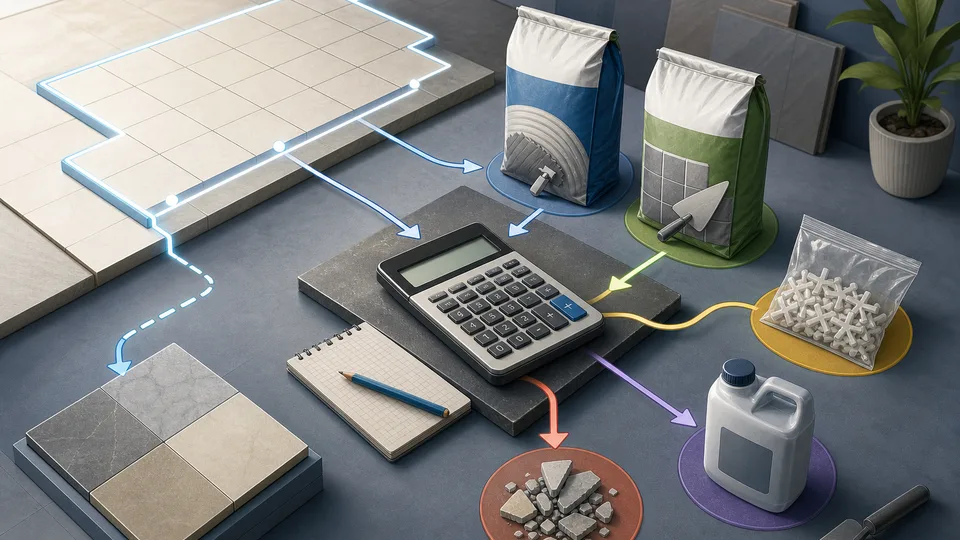
Buying enough tiles is only one part of a tiling job. You also need adhesive, grout, spacers, sometimes sealer or additive, and a plan for waste and bag rounding. Those materials are easy to underestimate because they are less visible than the tiles themselves.
A tile area estimate tells you how much surface is being covered. It does not automatically tell you how many bags of adhesive or grout to buy because product coverage, tile size, joint width, substrate, and waste assumptions all matter.
The Tile Adhesive & Grout Calculator helps estimate adhesive bags, grout bags, spacer packs, sealer or additive allowance, and material cost from manual product coverage and price inputs. It complements the Tile Calculator, which focuses on tile count.
Tile count is not the whole job
Tile calculators usually start with area and tile size. That gives a surface count plus waste for cuts and breakage. Adhesive and grout use different logic. They depend on coverage rates and how the material is applied.
It is possible to have enough tiles and still be short of adhesive halfway through the job. It is also possible to buy too much grout because the joint size, tile format, or product yield was guessed instead of checked.
Adhesive coverage comes from the product assumption
Adhesive is usually planned from area coverage per bag or tub. That coverage can vary by product, trowel notch, tile size, surface condition, and application thickness. The calculator does not know those site conditions; it uses the coverage figure you enter.
This is why the product data matters. If one bag covers 5 square metres under your assumptions and the tiled area is 18 square metres, the raw count is 3.6 bags. After rounding and waste, that becomes a practical purchase quantity.
Do not treat a calculator result as a product-system specification. The tool estimates quantities from entered assumptions; it does not decide the correct adhesive for wet areas, heated floors, large-format tiles, or specialist substrates.
Grout coverage depends on joints
Grout is not spread across the whole tile face in the same way adhesive sits behind the tile. It fills the joints between tiles. Joint width, joint depth, tile size, tile thickness, and product density can all affect usage.
For broad planning, many users work from a product coverage figure per bag. That is fine as long as the assumption matches the tile and joint situation closely enough for the job.
Small tiles with many joints usually need more grout than large tiles covering the same area. That is the kind of practical difference a simple area-only estimate can hide.
Spacers and accessories are small but annoying to miss
Spacer packs are not the most expensive part of most tiling jobs, but running out can slow the work. The same applies to mixing buckets, levelling clips, sealer, additive, sponges, and cleanup materials depending on the job.
The calculator includes spacer and sealer or additive allowance so the materials list is not limited to the two obvious bagged products. You may not need every accessory for every job, but the planning step makes the decision visible.
Waste and bag rounding matter
You cannot buy 2.3 bags of adhesive in a normal retail setting. You round up. You may also add waste for uneven surfaces, mixing loss, application variation, or small mistakes.
Rounding is not waste in the same sense as breakage. It is a buying constraint. Waste is the allowance for real-world loss. Both affect the final purchase quantity, so both need to be visible.
A simple example
Suppose a wall and floor area totals 16 square metres. The adhesive product is assumed to cover 5 square metres per bag. Raw adhesive need is 3.2 bags, so the practical count starts at 4. If you add a waste allowance, it may still round to 4 or move to 5 depending on the percentage.
Now suppose grout coverage is 12 square metres per bag for the chosen tile and joint assumptions. Raw grout need is 1.33 bags, so the practical count is 2 bags before any extra allowance.
The important point is that adhesive and grout do not share the same coverage. If you estimate both from tile count alone, one of them may be wrong.
When a bathroom or wet area needs more care
Bathrooms, showers, wet rooms, and splash zones often involve waterproofing systems, substrate preparation, movement joints, product compatibility, and installation standards. A quantity calculator is not the place to decide those requirements.
If the job involves wet-area compliance or product-system guarantees, follow the relevant manufacturer instructions and professional guidance. The calculator can still help with quantities after the system is chosen, but it should not choose the system.
For wider bathroom budgeting, the bathroom renovation cost guide can help place tiling materials inside the larger project cost.
Check the tile area before calculating bags
Adhesive and grout estimates inherit any mistake in the tile area. If the wall area is wrong, or if openings and exclusions are handled inconsistently, the bag counts will look precise while still being based on a weak input.
For straightforward rooms, measure each wall or floor section separately. For bathrooms and kitchens, note where tiles stop, where splashbacks begin, and whether full-height tiling is actually planned. A small change in tiled height can alter both tile count and setting materials.
Use the Tile Calculator first if the tile area or tile count is still uncertain. Then use the adhesive and grout calculator once the coverage area is clear.
Keep product coverage assumptions visible
Different products can cover different areas. Even the same product can behave differently depending on trowel size, surface flatness, tile format, and installation method. Hiding the coverage assumption makes the estimate hard to review later.
Write down the coverage figure used for adhesive and the coverage figure used for grout. If you change products before buying, update the calculator rather than carrying forward the old bag count.
This is especially useful when someone else is checking the list. A material list that says four bags of adhesive is less informative than a list that says four bags based on a chosen coverage assumption and waste allowance.
Common tile material mistakes
Using one coverage rate for everything. Adhesive and grout are different materials with different usage patterns.
Forgetting bag rounding. A raw result of 3.1 bags still means buying 4 bags in normal retail situations.
Ignoring accessories. Spacers, levelling clips, sealer, additive, primer, buckets, and cleanup materials may be minor individually but disruptive if missed.
Letting the calculator choose the product system. The tool estimates quantity from your assumptions. It does not decide waterproofing, substrate preparation, compatibility, or wet-area compliance.
Where material take-off fits
Tiling materials are often one group inside a wider project. If the same job also includes backer board, trim, primer, waterproofing, floor preparation, or disposal, use the Material Take-Off Calculator to keep the whole list organised.
FAQ
Can I estimate adhesive from tile count?
Not reliably. Adhesive is usually estimated from area and product coverage, not tile count alone.
Why does grout need a separate estimate?
Grout fills joints, so usage depends on tile size, joint width, depth, and product coverage. It does not follow adhesive usage exactly.
Should I add waste?
Yes. Add a reasonable allowance for mixing loss, application variation, surface conditions, and rounding. The exact allowance depends on the job and product.
Does this calculator cover waterproofing?
No. It estimates adhesive, grout, spacers, sealer or additive allowance, and material cost. Waterproofing systems, wet-area compliance, labour, and product suitability are outside its scope.